
TL;DR:
- Manual tracking creates errors, delays, and blind spots, hindering restaurant growth.
- Automated cost tracking provides real-time data, reducing errors and facilitating prompt decision-making.
- Choosing UK-specific tools with easy integration and focused features improves cost management and profitability.
Running an independent restaurant in the UK has never been tighter. With 40% of UK independents operating at break-even, the margin for financial error is almost non-existent. Yet most owners still rely on spreadsheets, paper invoices, and end-of-month guesswork to understand where their money is going. That approach creates dangerous blindspots. By the time you spot a cost problem, it has already eaten into your profit. Automating cost tracking changes that entirely, giving you real-time visibility, fewer errors, and the kind of financial clarity that lets you make confident decisions every single week.
Table of Contents
- Manual cost tracking: Common pitfalls and why independents struggle
- Automated cost tracking: Immediate benefits for UK restaurant owners
- Choosing UK-specific tools: Avoiding tech fatigue for independents
- Putting automation into practice: Steps for independent UK restaurants
- A hard-won lesson: Tech is only as good as its usage in UK restaurants
- Explore automation: Streamlining cost tracking in your UK restaurant
- Frequently asked questions
Key Takeaways
| Point | Details |
|---|---|
| Manual costs invite blindspots | Manual tracking often misses late invoices and creates blind spots in menu profitability. |
| Automation brings real-time visibility | Automated cost tracking provides owners with instant cost data and fast alerts to leaks. |
| Choose UK-focused solutions | Independent UK restaurants gain most from tools tailored to local operations, not generic platforms. |
| Pair data with decisive action | Maximum value comes when automated data is used for menu and supplier decisions, not just reporting. |
Manual cost tracking: Common pitfalls and why independents struggle
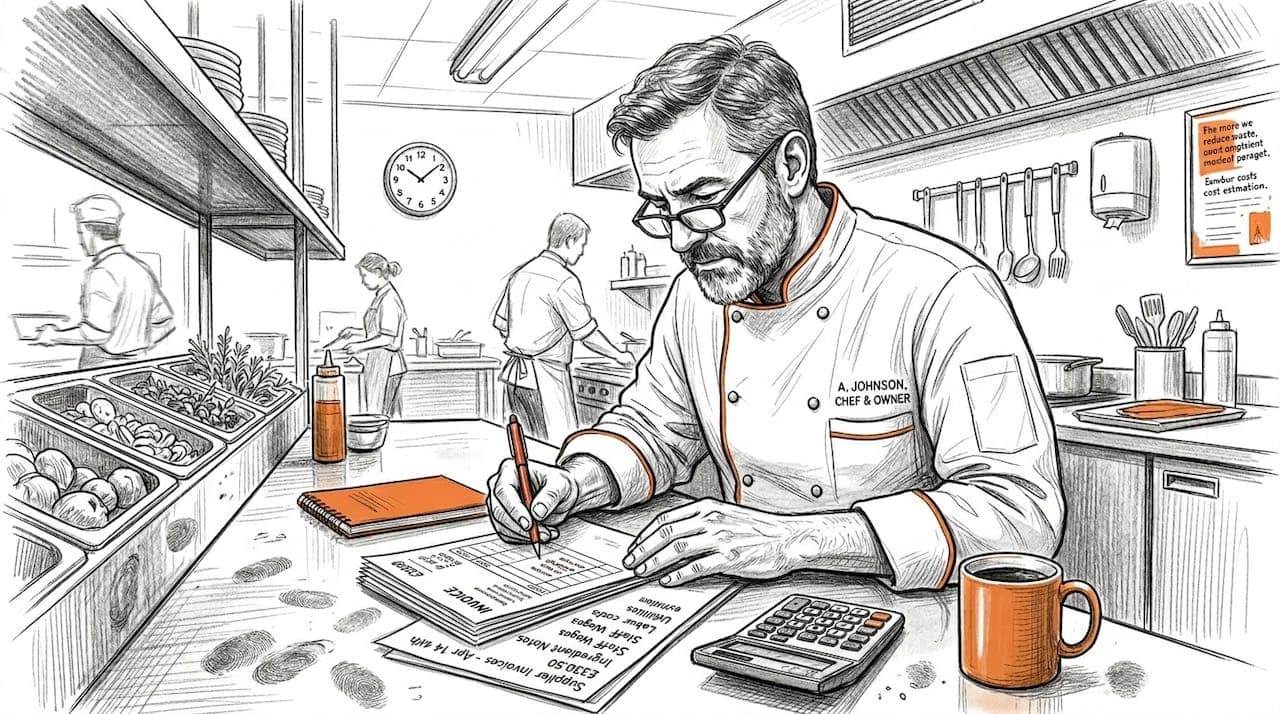
If you have ever spent a Sunday afternoon reconciling invoices and still felt unsure about your actual food cost percentage, you already know the problem. Manual tracking is not just slow. It is structurally unreliable for a busy kitchen environment where invoices arrive daily, prices shift without warning, and staff turnover means institutional knowledge disappears overnight.
The core issues with manual tracking include:
- Fragmented records: Invoices get lost, filed in different places, or never entered at all. A missed delivery note from your meat supplier can throw your entire weekly cost calculation off.
- Time-consuming data entry: Someone has to type every line item into a spreadsheet. That person is usually you, your head chef, or a manager who has better things to do during service.
- No real-time visibility: Spreadsheets only tell you what happened last week or last month. By then, a price spike from a key supplier has already done its damage.
- Menu-level blindspots: Without item-level cost data, it is nearly impossible to know which dishes are genuinely profitable and which are quietly draining your margin.
- Human error: A single transposition mistake in a spreadsheet can distort your food cost percentage for an entire period.
These are not small inconveniences. They are the reason so many independent restaurants struggle to grow beyond survival mode. Good food cost tracking tips can help, but manual processes will always have a ceiling.
The wider industry recognises this. Tech fatigue and fragmentation are consistently cited as the top pain points for UK independents when it comes to adopting new systems. Owners do not lack ambition. They lack time and clarity about which tools will actually deliver a return. The result is a patchwork of apps that do not talk to each other, creating more admin rather than less.
"The real cost of manual tracking is not just the hours spent on data entry. It is the decisions you cannot make because the data arrives too late or not at all."
The solution is not more spreadsheets. It is removing the manual layer entirely.
Automated cost tracking: Immediate benefits for UK restaurant owners
Automation does not replace your judgement as an operator. It gives your judgement something solid to work with. Instead of reviewing last month's costs and wondering what went wrong, you are looking at this week's numbers and deciding what to do about them right now.
The practical benefits are significant:
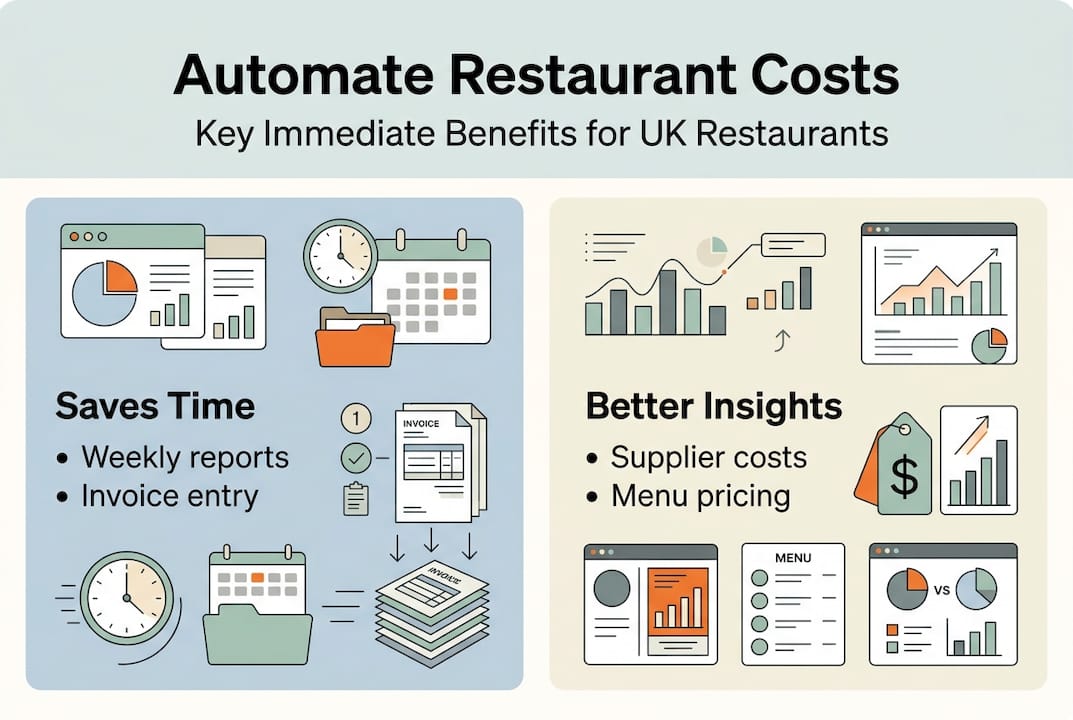
- Real-time spend visibility across all suppliers and categories
- Automatic invoice processing that extracts supplier, item, and cost data without manual entry
- Weekly cost reports that show food cost percentage and gross profit at a glance
- Instant identification of cost leaks before they compound over a full trading period
- Supplier comparison data that reveals where you are overpaying and where you could negotiate
Here is a simple comparison of what manual versus automated tracking looks like in practice:
| Metric | Manual tracking | Automated tracking |
|---|---|---|
| Time to produce weekly report | 3 to 5 hours | Under 10 minutes |
| Invoice processing accuracy | Variable, error-prone | Consistent, AI-verified |
| Cost visibility | Weekly or monthly | Real-time |
| Menu profitability insight | Rarely available | Built into dashboard |
| Supplier spend analysis | Manual calculation | Automatic breakdown |
The shift to real-time cost data is particularly powerful for independents because it levels the playing field. Real-time data and automation allow independents to match the operational efficiency of larger chains, without the enterprise budget or dedicated finance team.

Pro Tip: Once your cost data is automated, connect it directly to your menu decisions. If your beef supplier's prices have risen 12% this month, that information should trigger a menu review, not sit unnoticed in a spreadsheet until quarter end.
Automation also supports smarter supplier decisions. When you can see a clear breakdown of spend by supplier each week, you can identify which relationships are costing you more than they should and explore smart expense tracking strategies to diversify or renegotiate accordingly.
Choosing UK-specific tools: Avoiding tech fatigue for independents
Not all cost tracking tools are built with UK independent restaurants in mind. Generic accounting platforms may handle invoices, but they rarely speak the language of a restaurant operator. They do not show food cost percentage by default, they do not integrate with your EPOS system without expensive add-ons, and they often require a bookkeeper to interpret the output.
The difference between a generic tool and a UK-focused solution is significant:
| Feature | Generic accounting tool | UK-focused restaurant tool |
|---|---|---|
| Food cost percentage reporting | Rarely included | Built-in |
| Invoice scanning for hospitality | Basic or absent | AI-powered, category-mapped |
| EPOS and revenue integration | Limited | Designed for UK systems |
| Onboarding complexity | High | Quick and practical |
| Relevant support | General finance | Hospitality-specific |
The recommendation from industry research is clear: prioritise focused UK-specific tools over complex enterprise systems, particularly for independents where time and resource are limited.
To avoid tech fragmentation when selecting a cost tracking system, follow these steps:
- Audit your current tools: List every platform you currently use for invoices, accounting, and reporting. Identify overlaps and gaps.
- Define your core need: For most independents, that is food cost percentage visibility and supplier spend tracking. Do not buy a platform that does fifty things if you only need three.
- Check UK integrations: Confirm the tool connects with systems you already use, such as Xero, Square, or your existing EPOS.
- Evaluate onboarding time: If setup takes weeks, it will not get done. Look for platforms that get you to useful data within a day or two.
- Assess reporting relevance: Reports should show you what a restaurant operator needs to see, not what an accountant needs to audit.
Pro Tip: One dashboard that consolidates your cost data is worth more than three separate apps that each show you a fragment of the picture. Fragmentation is the enemy of fast decisions.
Exploring automated expense tracking UK options designed for hospitality will save you significant time compared to adapting generic software. And once you have the right tool, building a cost control workflow around it becomes straightforward.
Putting automation into practice: Steps for independent UK restaurants
Knowing that automation is valuable and actually implementing it are two different things. The good news is that starting is simpler than most owners expect, particularly with modern platforms built specifically for hospitality.
Here is a practical sequence to get started:
- Choose one platform and commit to it: Avoid the trap of trialling five tools simultaneously. Pick one that fits your core needs and give it a proper four-week trial.
- Upload your existing invoices: Most platforms accept photos, PDFs, or email forwarding. Start with the last four weeks of invoices to establish a baseline.
- Connect your revenue data: Link your EPOS or payment system so the platform can calculate food cost percentage automatically against real sales figures.
- Set a weekly review habit: Automation generates the data. You still need to look at it. Block thirty minutes every Monday morning to review the previous week's costs.
- Act on what you find: Use your expense tracking process to flag anomalies, review supplier pricing, and adjust menus accordingly.
The research is clear that the biggest gains come when you pair automation with menu engineering and supplier diversification. Automation gives you the data. Menu engineering and supplier negotiation are where you turn that data into actual savings.
Common mistakes to avoid when implementing automation:
- Uploading invoices inconsistently: Gaps in your data produce unreliable reports. Build a habit of uploading every invoice within 24 hours of receipt.
- Ignoring the reports once set up: Automation is not a set-and-forget solution. Regular review is what converts data into decisions.
- Over-complicating the setup: Start with the basics. Food cost percentage and supplier spend are enough to drive meaningful action in the first month.
- Skipping the revenue connection: Cost data without revenue context tells you very little. Always connect your sales figures.
Using a food cost control checklist alongside your automation platform ensures nothing falls through the gaps during the transition period.
A hard-won lesson: Tech is only as good as its usage in UK restaurants
Here is something the software industry rarely tells you: the platform is not the answer. The platform is just the enabler. We have seen independent restaurants invest in automation tools and see zero improvement in profitability, not because the tool failed, but because the data was never acted upon.
The real value of automation is the conversation it forces you to have with your own numbers. When you are monitoring food costs weekly rather than monthly, you stop being reactive and start being strategic. That shift in mindset is what separates the restaurants that survive a tough trading year from the ones that do not.
Avoid software fatigue by keeping your tech stack lean. One platform that does the core job well beats four platforms that each do a small piece. And remember, the goal is not to have impressive software. The goal is to have a profitable restaurant. Automation is the tool. Your decisions are what make the difference.
Explore automation: Streamlining cost tracking in your UK restaurant
If this guide has shown you anything, it is that the gap between knowing your costs and acting on them comes down to having the right data at the right time. Manual tracking cannot deliver that reliably.
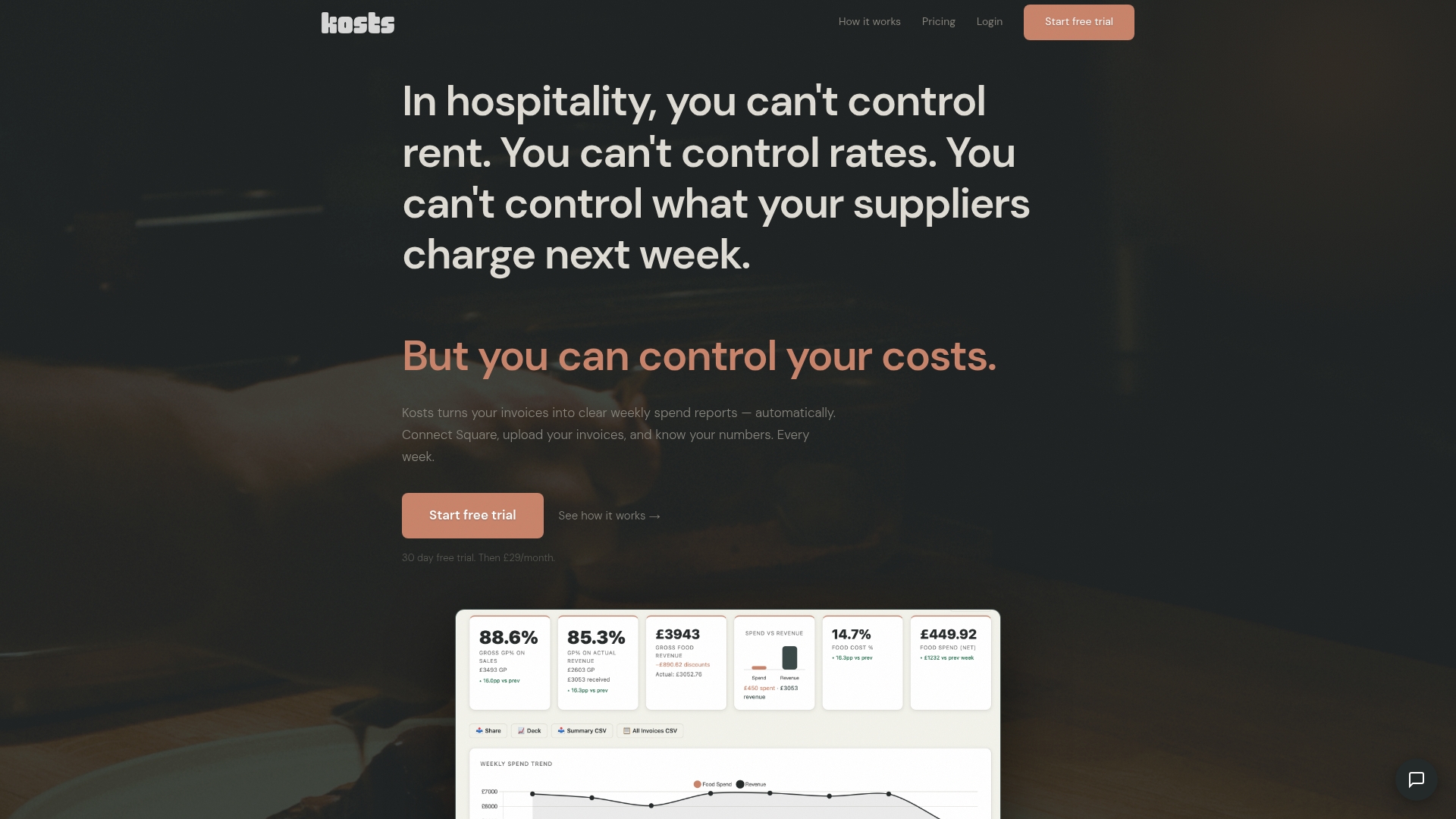
Kosts is built specifically for UK independent restaurants, giving you automated invoice scanning, real-time cost reports, and a dashboard that speaks your language as an operator. Built by a working chef, it connects with Square and Xero, gets you set up quickly, and shows you your food cost percentage and supplier spend every single week. Try it free for 30 days and see exactly where your money is going.
Frequently asked questions
How does automating cost tracking improve restaurant profits?
Automation delivers real-time visibility into your costs, reducing errors and allowing you to act quickly when prices rise or margins tighten. Real-time data gives independents the same operational efficiency as larger chains without the overhead.
What features should UK independent restaurants look for in a cost tracking system?
Prioritise UK-relevant integrations, straightforward weekly reporting, and a single dashboard that shows food cost percentage and supplier spend. Focused UK-specific tools are consistently recommended over complex enterprise platforms for independents.
Does automated cost tracking work for small restaurants with limited staff?
Absolutely. Automation removes the manual data entry burden, meaning even a two-person operation can produce accurate weekly cost reports without dedicating hours to admin. Automation is essential precisely because independent teams are small.
How does cost automation support menu engineering and supplier selection?
When you can see item-level cost data in real time, you can identify which dishes need repricing and which suppliers are becoming too expensive to rely on. Pairing automation with menu engineering and supplier diversification is where the biggest financial gains are made.