
TL;DR:
- UK independent restaurants operate with very narrow profit margins of 3 to 5 percent.
- Controlling prime costs, including food and labour, is essential to protect profitability.
- Automated systems and weekly tracking are key for effective cost management and continuous improvement.
Running an independent restaurant in the UK means operating on a razor's edge. Net profit margins typically sit at just 3 to 5%, and for independents, that number can be even lower. A single bad week of food waste, an unexpected supplier price rise, or an over-staffed rota can wipe out a month's gains. Cost control is not a back-office task you delegate or delay. It is the most powerful lever you have for protecting your restaurant's future. This guide walks you through the exact methods, tools, and habits that turn cost pressure into controlled, sustainable profit.
Table of Contents
- Understanding your restaurant's true costs
- Preparing for cost control: What you need in place
- Executing cost control: Proven methods that work
- Monitoring results and continuous improvement
- Why most restaurant cost control advice misses the mark
- Take the next step in cost control
- Frequently asked questions
Key Takeaways
| Point | Details |
|---|---|
| Know your numbers | Understanding and regularly tracking food, labour, and prime costs enables timely and effective control. |
| Automate for accuracy | Digital tools dramatically cut errors and waste compared to manual systems. |
| Act and review weekly | Success hinges on consistent execution, monitoring, and refinement—not set-and-forget solutions. |
| Tackle food waste | Reducing waste lowers costs and boosts profitability, with 20% savings possible through better tracking. |
Understanding your restaurant's true costs
Before you can control costs, you need to know precisely what you are dealing with. Many owners focus on revenue when the real story lives in the numbers behind it.
Prime cost is your single most important financial metric. It is the combined total of your food costs and labour costs expressed as a percentage of revenue. For UK independents, the prime cost target sits between 55 and 65% of revenue. Anything above that, and your margins are being squeezed from both ends.
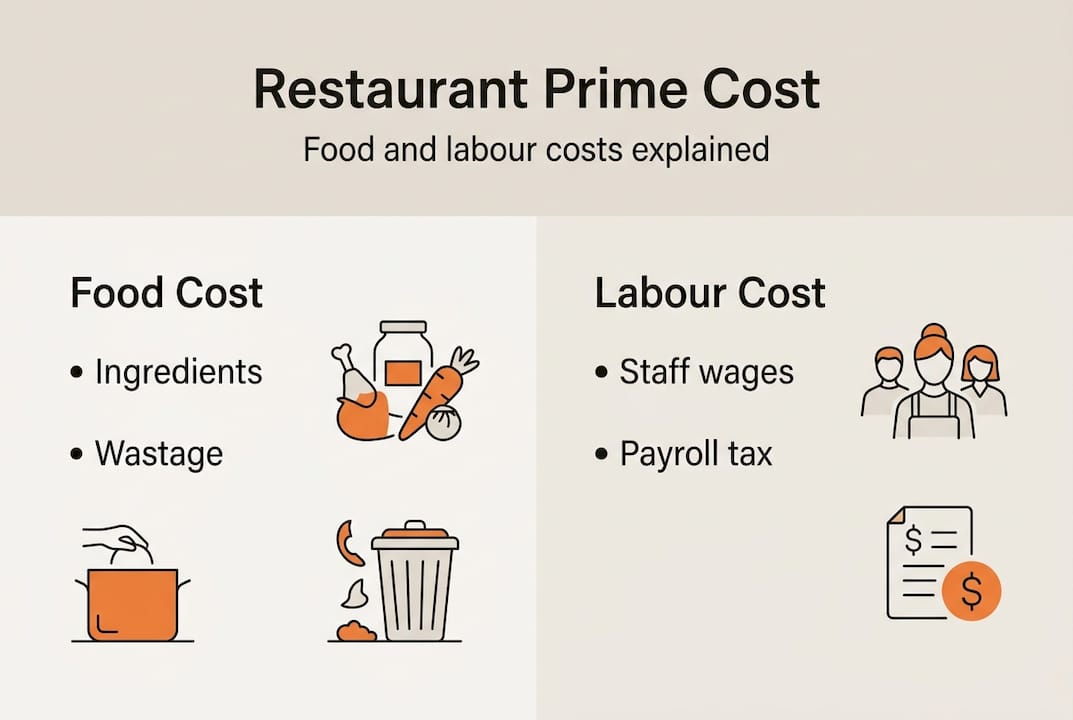
Food cost represents what you spend on ingredients relative to what you bring in. The widely accepted food cost benchmark for UK restaurants is 28 to 35% of revenue. Labour cost, covering wages, national insurance, and holiday pay, should sit in the 25 to 35% range. Together, these form the backbone of your prime cost calculation.
| Cost category | Typical UK target (% of revenue) |
|---|---|
| Food cost | 28–35% |
| Labour cost | 25–35% |
| Prime cost (combined) | 55–65% |
| Net profit | 3–5% |
Tracking these numbers weekly, not monthly, is what separates operators who spot problems early from those who discover them at year-end. Weekly data gives you the ability to react before a bad trend becomes a crisis.
For deeper guidance on reducing your ingredient spend specifically, explore these food cost control methods used by UK restaurants and these food cost tracking tips to sharpen your process.
Some of the most common sources of unnoticed cost creep include:
- Portion sizes drifting upward without recipe updates
- Unlogged staff meals and wastage
- Over-ordering perishables with no par level discipline
- Supplier invoice errors going unchecked
- Unprofitable specials added to the menu without a costed recipe
- Energy and consumables excluded from operational cost reviews
Pro Tip: Weigh key ingredients at the pass as well as during prep. A 10-gram drift on a protein dish, multiplied across 40 covers a night, adds up to a meaningful cost variance by the end of the week.
Preparing for cost control: What you need in place
Knowing your targets is only useful if you have the systems to measure against them. Getting the foundations right before acting saves hours of frustration later.
At a minimum, you need a reliable POS system, a consistent method for recording daily or weekly sales, an inventory tracking process, and a wastage log. Without these, any cost control effort is guesswork.

| Tool | Manual approach | Digital/automated approach |
|---|---|---|
| Invoice tracking | Paper files, spreadsheets | AI invoice scanning, auto-categorisation |
| Inventory counts | Physical counts, handwritten records | App-based counts, par level alerts |
| Sales data | End-of-day cash reconciliation | POS integration, automatic revenue import |
| Wastage logging | Notebook entries | Digital logs with real-time reporting |
| Cost reporting | Monthly spreadsheet builds | Weekly automated dashboards |
Manual approaches are not worthless, but they create gaps. Digital tools close those gaps consistently. Weekly inventory counts, FIFO stock rotation (first in, first out), and par level setting are the operational disciplines that prevent waste before it happens.
Here is a practical preparation sequence to follow:
- Audit your current records. Identify where data is missing or inconsistent.
- Set up a standardised recipe file with costed portions for every dish.
- Establish par levels for all key ingredients based on average weekly usage.
- Define your wastage log process and assign responsibility to a team member.
- Choose your tracking method, whether manual, spreadsheet, or digital platform.
- Set a fixed weekly review time so cost analysis becomes routine, not reactive.
A proper cost control checklist can help you move through this preparation stage methodically. For broader financial discipline, these expense management tips cover the wider operational picture.
Executing cost control: Proven methods that work
With your systems in place, the focus shifts to applying the methods that consistently deliver results in UK restaurant operations.
The most effective cost control strategies combine menu discipline, purchasing rigour, and operational precision. Here is how to put them into practice:
- Menu engineering: Categorise every dish by popularity and gross profit margin. Promote high-GP items visually. Retire or reprice dishes that sell well but contribute little to profit.
- Recipe costing: Cost every dish to the gram and update costs whenever a supplier price changes. A recipe that was profitable six months ago may no longer be.
- Supplier negotiations: Use your purchase data to negotiate volume deals or lock in prices where possible. Consolidating suppliers also reduces admin time and invoicing errors.
- Waste logging: Record every item discarded, overproduced, or returned. Patterns in wastage data show where purchasing, portioning, or storage is breaking down.
- Staff scheduling: Cross-reference your labour rota against forecasted covers and revenue. Overstaffing on quiet nights is one of the fastest ways to inflate your labour cost percentage.
- POS and inventory integration: Linking your point of sale directly to your inventory system creates automatic stock depletion and flags discrepancies in real time.
Pro Tip: Run a weekly "GP spotlight" with your kitchen team. Show them which dishes generate the most profit per plate. This creates genuine engagement with cost goals and often prompts creative ideas for improvement.
"Automation via POS-inventory integration can cut manual errors by 90% and reduce food waste by 20%, making it one of the highest-return investments available to independent operators."
For a broader view of your operational outgoings, these operating cost strategies are worth reviewing alongside your food and labour focus. Solid budgeting tips will also help you plan spending against realistic revenue projections, and if you want to reduce the manual burden, learn how to automate cost tracking effectively.
Monitoring results and continuous improvement
Implementing methods is just the start. The restaurants that hold onto their gains are the ones that build review into their weekly routine.
Follow this sequence to evaluate whether your cost control is working:
- Track prime cost weekly. Compare this week's figure against your target and the previous four weeks. Look for trends, not just individual results.
- Review your wastage log every Monday. Identify the top three wasted items and investigate why. Was it over-ordering, poor storage, or a menu item that did not sell?
- Check food and labour cost percentages separately. A prime cost in range can still hide one component running too high if the other is unusually low.
- Adjust menus and purchasing monthly. Use your data to make informed changes, rather than waiting for a supplier invoice shock or a bad P&L.
The scale of the problem makes ongoing monitoring essential. UK restaurants waste approximately 22% of all food purchased, a figure valued at £3.2 billion annually across the sector. Digital tools have demonstrated a 20% reduction in food waste, which at that scale represents a substantial recovery of margin.
Beyond the obvious numbers, watch for subtler warning signs. A slowly shrinking gross profit percentage without an obvious cause can signal untracked wastage, theft, or portion creep. Regular till reconciliation and spot-checking delivery weights against invoices catches problems that standard reporting misses.
Building these reviews into your week makes cost control a habit rather than a crisis response. Real-time cost tracking removes the lag between spending and awareness, while a well-designed cost control workflow keeps the whole process manageable even during busy service weeks.
Why most restaurant cost control advice misses the mark
Most articles on cost control hand you a list of tactics and leave you to get on with it. That is the problem. Tactics without an underlying system change produce short-term wins that disappear the moment the kitchen gets busy or a key team member leaves.
The uncomfortable truth is that manual tracking systems are fundamentally incompatible with the pace of real-world hospitality. A spreadsheet updated once a week by an exhausted manager at midnight is not a cost control system. It is a record of damage already done.
Many owners avoid automation because they assume it is complicated or expensive. That assumption is outdated. The real complexity is in maintaining manual processes across a team that has better things to focus on during service. Switching to automated expense tracking removes the friction and delivers the kind of immediate, consistent visibility that actually changes behaviour.
The operators we see making the most progress are not necessarily cutting costs harder than everyone else. They are simply looking at accurate, timely data and making faster decisions as a result. That is the real competitive advantage.
Take the next step in cost control
If this guide has clarified where your operation needs work, the next move is to build the right infrastructure around those insights.
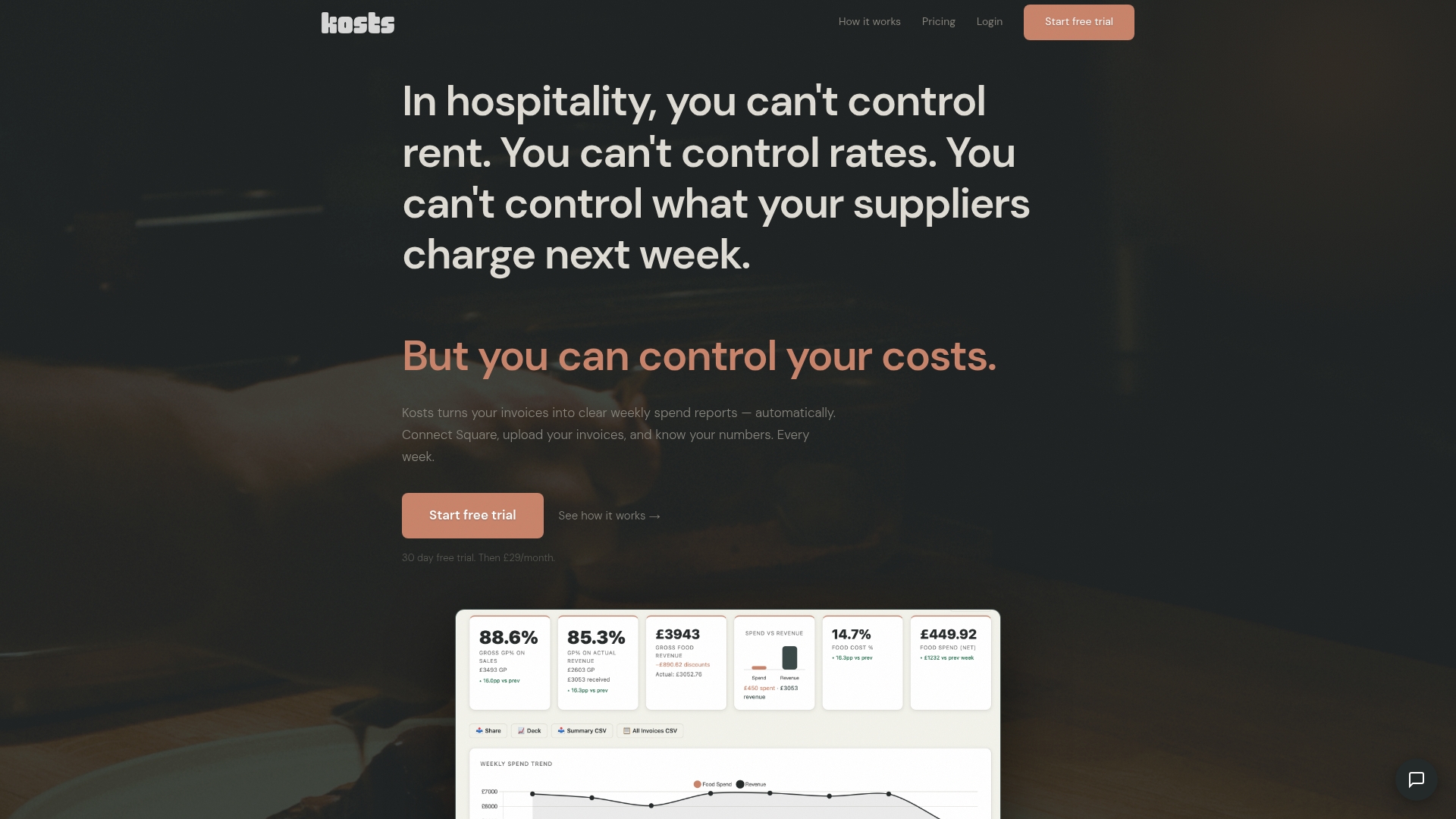
Kosts is built specifically for independent UK restaurants and food service operators who want clear, weekly visibility into their costs without the complexity of enterprise software. Upload invoices by photo, PDF, or email. Connect your Square or Xero account for automatic revenue import. Get a real-time breakdown of food cost, gross profit, and supplier spend on a dashboard that actually makes sense. Our platform gives you the cost control tools to act on what you have learned here. Start your 30-day free trial today and see how quickly the numbers can change.
Frequently asked questions
What is the prime cost in a UK restaurant?
Prime cost is the combined total of food and labour costs as a percentage of revenue. For UK independents, the recommended target is 55 to 65%.
How often should UK restaurants review their food and labour costs?
Weekly calculation is best practice, as it allows you to catch overspending early rather than discovering problems at month-end.
What percentage of revenue should food costs be for UK restaurants?
The standard food cost benchmark is 28 to 35% of revenue, though this varies by menu style, concept, and ingredient mix.
Can automation really reduce restaurant cost errors and waste?
Yes. POS-inventory integration has been shown to cut manual errors by 90% and reduce food waste by 20% in real-world restaurant settings.
How much food do UK restaurants waste on average?
On average, 22% of purchased food is wasted across UK restaurants, representing approximately £3.2 billion in lost value each year.