
TL;DR:
- Regularly tracking food costs helps prevent profit loss in restaurants.
- Accurate data, updated recipes, and waste monitoring are crucial for effective cost control.
- Automated tools like Kosts simplify calculation and improve ongoing food cost management.
Poor food cost tracking is one of the fastest ways to quietly drain profit from an independent restaurant. Many owners discover the problem only when margins have already shrunk, and by then the damage is done. A clear, repeatable workflow changes that entirely. This guide walks you through every stage of calculating food costs accurately, from understanding core terminology to verifying your numbers and improving them over time. Whether you are running a neighbourhood bistro or a busy high street café, the steps below will give you a practical framework you can apply straight away.
Table of Contents
- Understanding food cost calculation basics
- Preparing your restaurant for efficient calculation
- Step-by-step food cost calculation workflow
- Verifying and improving your food cost outcomes
- A smarter approach to food cost management: Lessons learned
- Streamline your food cost workflow with Kosts
- Frequently asked questions
Key Takeaways
| Point | Details |
|---|---|
| Clear workflow matters | An organised food cost workflow prevents profit losses and supports menu decisions. |
| Preparation is essential | Successful cost calculation starts with accurate data and appropriate tools. |
| Menu engineering pays off | Using real-time data and regular reviews enhances menu profitability and food cost control. |
| Continuous improvement | Periodic validation and recipe updates keep food costs optimised. |
Understanding food cost calculation basics
Food cost is the total amount you spend on ingredients to produce a dish or run your kitchen over a given period. It sounds simple, but many owners confuse it with overall operating costs, which also include labour, rent, and utilities. Keeping these figures separate is essential because food cost alone tells you whether your menu is priced correctly.
Three terms come up constantly in this space. Portion cost is what a single serving of a dish costs to make. Recipe cost is the combined ingredient cost for a full recipe batch. Gross profit is what remains after subtracting food cost from your revenue. Understanding how these three interact is the foundation of monitoring food costs effectively.
Regular calculation matters because ingredient prices shift constantly. A supplier price increase of just 5% on your top ten ingredients can turn a profitable dish into a loss-maker within weeks. Without a routine, you will not notice until it shows up in your end-of-month figures.
Here is a quick comparison of common calculation methods and what each one delivers:
| Method | Effort level | Key outcome |
|---|---|---|
| Manual spreadsheet | High | Full control, slow updates |
| POS-linked software | Medium | Faster data, some automation |
| Dedicated cost platform | Low | Real-time visibility, automated reports |
| Periodic manual audit | High | Spot-check accuracy, not ongoing |
When analysing food costs, the metrics that matter most are:
- Food cost percentage (food cost divided by revenue, multiplied by 100)
- Gross profit per dish
- Variance between theoretical and actual food cost
- Waste as a percentage of total ingredient spend
- Supplier price changes week on week
Applying dish costing techniques such as menu engineering, which categorises dishes into stars, puzzles, plows, and dogs based on profitability and popularity, gives you a structured way to act on these metrics rather than just observe them.
Preparing your restaurant for efficient calculation
Before you calculate anything, you need the right inputs in place. Trying to cost a menu without accurate supplier invoices, current portion weights, and up-to-date recipe records is like trying to navigate without a map. You will get somewhere, but probably not where you intended.

Here is what you need to have ready:
| Resource | Purpose | Who is responsible |
|---|---|---|
| POS system | Revenue and sales data | Manager |
| Inventory software | Stock levels and usage | Kitchen lead |
| Supplier invoices | Current ingredient prices | Owner or finance |
| Standardised recipe cards | Portion and ingredient data | Head chef |
| Spreadsheet or cost platform | Calculation and reporting | Manager or owner |
The preparation steps that most owners skip are the ones that cause the most errors later. Work through this checklist before you start:
- Standardise all recipe cards with exact weights and measures
- Confirm current prices with every active supplier
- Reconcile your last stock count against purchase records
- Assign clear ownership of data entry to a specific team member
- Decide on your calculation frequency (weekly is strongly recommended)
A solid food cost control checklist will help you avoid gaps in your preparation. For a broader view of how this fits into your operations, a restaurant cost control workflow gives you the full picture.
Applying recipe update strategies regularly, particularly after supplier price changes, keeps your cost data accurate and prevents silent margin erosion.
Pro Tip: Set a recurring calendar reminder every Monday morning for a ten-minute ingredient price review. Compare your latest invoices against the prices in your recipe cards. This one habit prevents weeks of miscalculation building up unnoticed.
Step-by-step food cost calculation workflow
With your data and tools in place, you can follow this workflow from start to finish. Each step builds on the last, so skipping ahead will introduce errors.
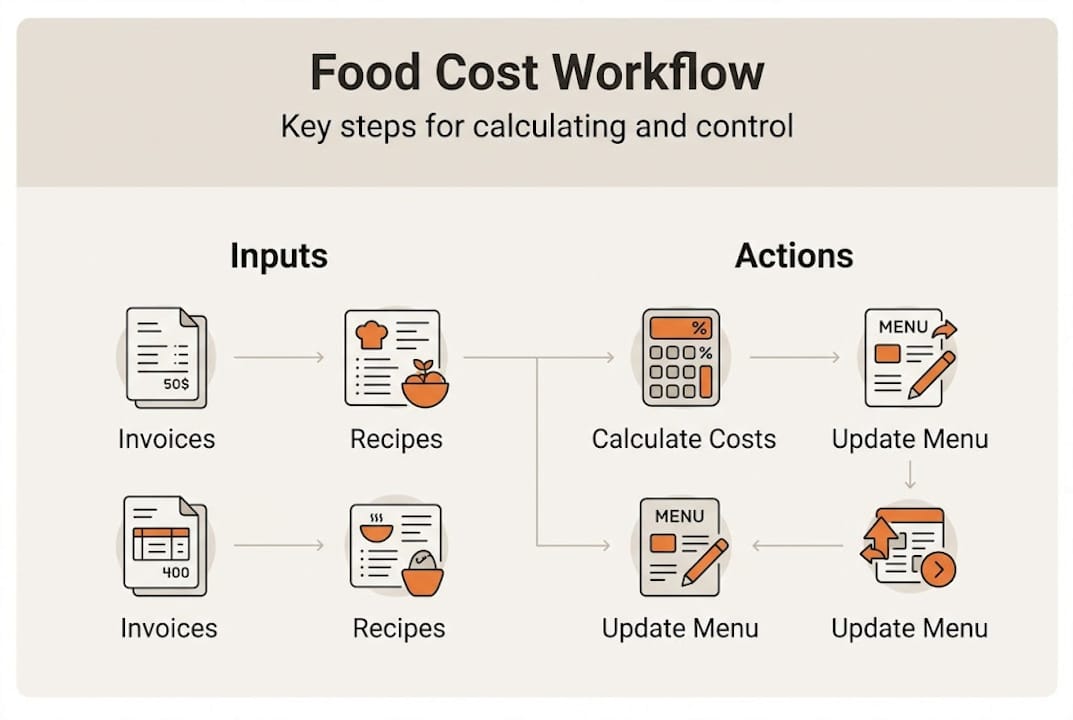
- Gather current supplier invoices for all ingredients purchased in the period you are costing.
- Update your recipe cards with the latest prices per unit (per kilogram, per litre, per item).
- Calculate portion cost for each dish by multiplying ingredient quantities by their current unit prices.
- Total the recipe cost across all dishes to understand your full menu cost profile.
- Record actual sales volume from your POS system for the same period.
- Calculate food cost percentage using the formula: (total food cost divided by total food revenue) multiplied by 100.
- Apply menu engineering methods by categorising each dish using menu engineering methods into stars (high profit, high popularity), puzzles (high profit, low popularity), plows (low profit, high popularity), and dogs (low profit, low popularity).
- Adjust pricing or recipes based on category. Stars stay as they are. Puzzles need better promotion. Plows need a cost reduction or price increase. Dogs need replacing.
Here is a practical example. Suppose your fish pie uses 200g of salmon at £18 per kilogram, 150g of potato at £0.80 per kilogram, and 50ml of cream at £2.50 per litre. The portion cost is £3.60 plus £0.12 plus £0.13, totalling £3.85. If you sell it for £14.50, your food cost percentage is 26.5%, which sits comfortably within the typical 25 to 35% target range for UK restaurants.
For food cost control examples like this across a full menu, the pattern quickly reveals which dishes are working and which are quietly costing you money. Consistent tracking food costs each week turns this from a one-off exercise into a reliable management tool.
Pro Tip: When negotiating with suppliers, bring three to six months of purchase history to the conversation. Showing consistent volume gives you genuine leverage, and suppliers are far more likely to hold prices or offer discounts when they can see you are a reliable account.
Verifying and improving your food cost outcomes
Calculating food costs once is useful. Verifying and refining them over time is what actually protects your margins. Many restaurants do the initial work and then let the numbers drift, which means errors accumulate silently.
Common mistakes to watch for:
- Using outdated ingredient prices in recipe cards
- Failing to account for prep waste (for example, the weight of vegetable peelings or fish bones)
- Not updating portion sizes after a recipe change
- Mixing theoretical costs with actual costs without distinguishing between them
- Ignoring small variances that add up significantly over a month
To spot inaccuracies, compare your theoretical food cost (what the numbers say you should have spent) against your actual food cost (what your invoices and stock counts confirm you did spend). A gap of more than 3 to 4% is a signal that something is off, whether that is theft, waste, over-portioning, or data entry errors.
Waste tracking is not optional. Unrecorded waste is one of the most common reasons actual food costs exceed theoretical costs, and it is almost always fixable once you can see it clearly.
Applying waste reduction techniques such as logging trim waste by dish and reviewing it weekly gives you the data to adjust both purchasing quantities and portion specifications. This is a core part of optimising restaurant costs over the long term.
Once you have verified your numbers, use them to make specific changes. Adjust recipes where ingredient costs have risen. Reprice dishes where your food cost percentage has crept above 35%. Use your restaurant cost reports to track whether changes are having the intended effect. Improvement is not a one-time event. It is a cycle of measure, verify, adjust, and repeat.
A smarter approach to food cost management: Lessons learned
Most articles on food cost calculation focus on the maths and stop there. The uncomfortable truth is that the maths is the easy part. The hard part is building the habit of actually doing it consistently, especially when service is busy and admin feels like a burden.
Conventional wisdom says to review costs monthly. In practice, monthly reviews mean you are always reacting to problems that are already four weeks old. Weekly reviews, even brief ones, let you catch issues while they are still small. A ten-minute team check-in every Monday, where someone confirms that recipe prices are current and that waste logs are up to date, is worth more than a two-hour monthly audit.
Investing in automated tools is not an extravagance. It is the only realistic way to sustain this discipline without burning out your team. Platforms that pull invoice data automatically and surface your food cost percentage without manual entry remove the friction that causes most owners to skip the process entirely. Pairing that with restaurant accounting tips gives you a complete financial picture, not just a food cost snapshot. The restaurants that manage costs well are not doing more work. They have made the work easier.
Streamline your food cost workflow with Kosts
Putting this workflow into practice requires accurate, up-to-date data at every stage. That is exactly what Kosts app is built to deliver for independent UK restaurants.
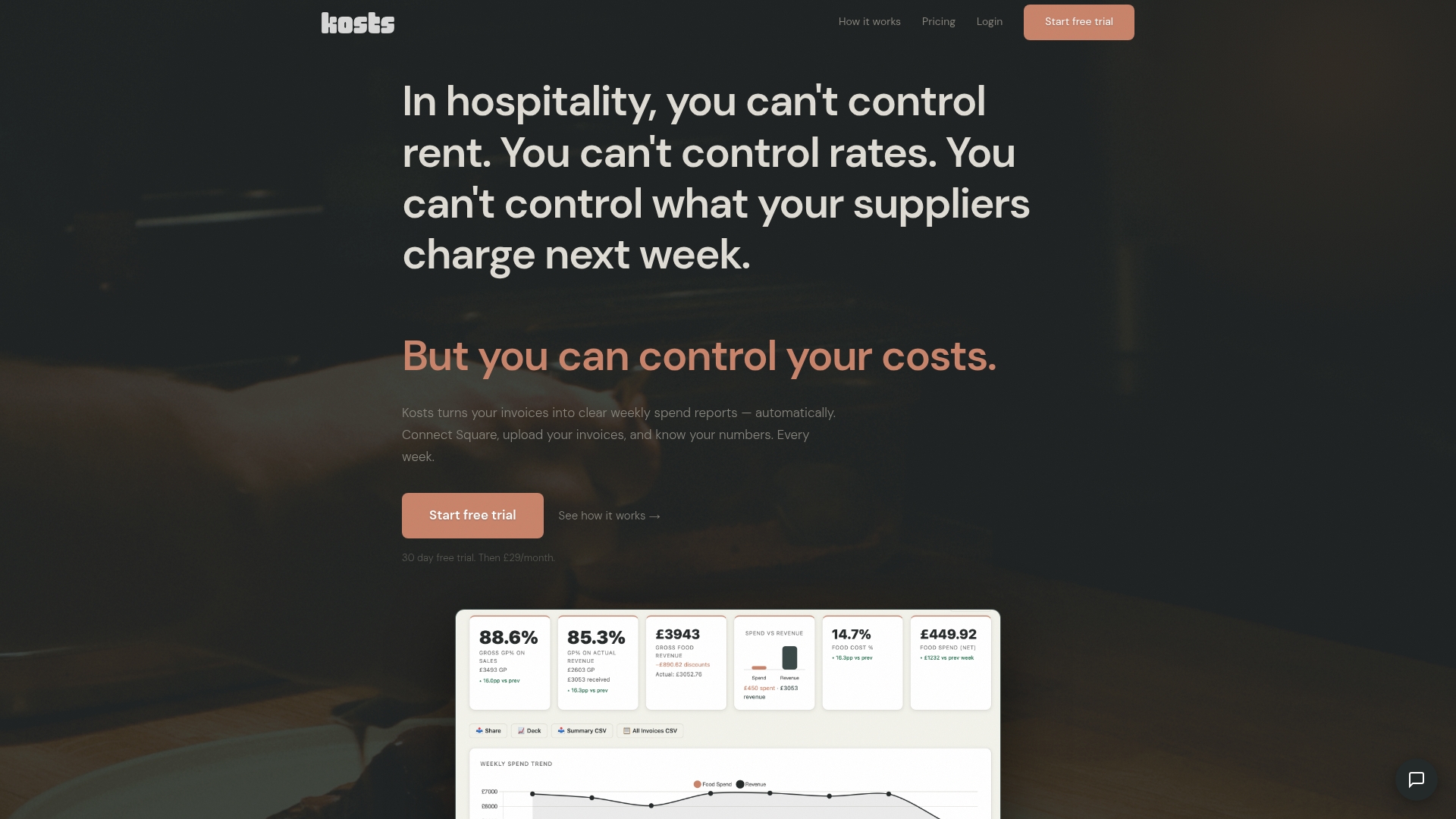
Kosts converts your supplier invoices into automated weekly cost reports using AI scanning. You upload a photo, a PDF, or forward an email, and the platform extracts supplier, item, category, and cost data instantly. It integrates with Square and Xero, so your revenue figures are always current. The result is a live food cost percentage on your dashboard without a single manual calculation. If you are ready to replace spreadsheets with a smarter approach, explore the efficient workflow methods that Kosts supports and start your 30-day free trial today.
Frequently asked questions
How often should food costs be calculated in a restaurant?
Food costs should be calculated at least weekly, as regular recipe updates and timely reviews allow you to catch price changes and waste issues before they compound into larger losses.
What's the most common mistake in food cost calculation?
The most common mistake is failing to update portion sizes or ingredient prices after supplier changes, which means your calculations reflect old data rather than current reality. Portion control and recipe updates are the foundation of accurate costing.
How can waste tracking improve food cost efficiency?
Tracking waste highlights exactly where ingredients are being lost before they reach the plate, allowing you to adjust purchasing quantities and portion specs. Waste tracking is central to keeping actual costs aligned with theoretical costs.
Are there tools to automate food cost calculation?
Yes, platforms like Kosts app automate invoice scanning, ingredient tracking, and cost reporting, removing the manual effort that causes most independent restaurants to let their food cost workflows lapse.