

Food costs are the single biggest variable expense in your restaurant, and most independent operators are losing money without realising it. A poorly tracked kitchen can bleed profit through waste, over-ordering, and portion drift, often without any obvious warning signs. The difference between a restaurant that struggles and one that thrives frequently comes down to how closely the owner watches what goes in and out of the kitchen. This article gives you practical, proven strategies to track food costs properly, so you can protect your margins and make decisions based on real numbers.
Table of Contents
- Understanding the importance of food cost tracking
- Criteria for an effective food cost tracking system
- Top food cost tracking tips for restaurant owners
- Comparing food cost tracking methods
- Situational recommendations: which approach is best for you?
- Streamline your food cost tracking with smart tools
- Frequently asked questions
Key Takeaways
| Point | Details |
|---|---|
| Track food costs weekly | Consistently reviewing food costs each week gives you a clear picture and helps spot problems early. |
| Choose the right system | Select a tracking method that fits your restaurant's size, skill level, and workflow to ensure you keep up with it. |
| Automate for accuracy | Automation reduces mistakes and saves staff time, making food cost tracking more reliable and efficient. |
| Focus on key metrics | Keep a close eye on cost of goods sold and wastage, as these drive your profit margin the most. |
Understanding the importance of food cost tracking
Food cost tracking is not just an accounting exercise. It is the foundation of every profitable menu decision you make. When you know exactly what you are spending on ingredients relative to what you are earning, you can spot problems early and act before they compound.
The two metrics you need to understand first are cost of goods sold (COGS) and food cost percentage. COGS is the total cost of all ingredients used to produce your sales in a given period. Food cost percentage is simply your COGS divided by your revenue, multiplied by 100. For most UK restaurants, a healthy food cost percentage sits between 28% and 35%, though this varies by concept.
The financial impact of getting this right is significant. A 3% reduction in food costs can increase restaurant profit margins significantly, which for a restaurant turning over £500,000 a year could mean an extra £15,000 in your pocket. That is not a rounding error. That is a member of staff, a kitchen upgrade, or simply a better night's sleep.
Common pitfalls that independent operators fall into include:
- Not recording every purchase, especially cash or card buys from cash-and-carry
- Failing to account for waste, spoilage, and staff meals
- Doing inventory counts too infrequently to catch drift
- Using different portion sizes depending on who is cooking
- Relying on memory or rough estimates rather than written records
"You cannot manage what you do not measure. Without consistent food cost data, every menu pricing decision is essentially a guess." This is why food cost analysis is treated as a core operational discipline in well-run kitchens, not an optional extra.
The good news is that even modest improvements in tracking accuracy translate directly into better margins. You do not need to overhaul your entire operation overnight.
Criteria for an effective food cost tracking system
Not every tracking system suits every restaurant. Before you commit to a method, it helps to know what you are actually looking for. The right system balances accuracy and user-friendliness for busy operators, because a system that is technically perfect but never used is worthless.
Here are the core criteria to evaluate any tracking approach:
- Accuracy: Does it capture all purchases, including small cash buys and delivery discrepancies?
- Ease of use: Can your team actually use it without significant training?
- Affordability: Does the cost of the system make sense relative to the savings it generates?
- Frequency: Does it support weekly or even daily tracking, not just monthly summaries?
- Integration: Can it connect with your till system, accounting software, or supplier invoices?
A good UK restaurant cost control checklist will include all of these criteria as standard. When you are evaluating options, also consider whether the system supports restaurant budgeting tips beyond just food costs, since labour and overhead tracking often sit alongside food cost management in practice.
Pro Tip: Start with the simplest system that gives you reliable weekly numbers. A basic spreadsheet done consistently beats a sophisticated app used sporadically. Once you have the habit, you can scale up to more powerful tools.
Top food cost tracking tips for restaurant owners
These are the methods that actually move the needle for UK independent restaurants. Best practices help identify wastage, theft, and menu inefficiencies that would otherwise stay hidden.
-
Conduct weekly inventory counts. Count your stock at the same time every week, ideally before your busiest trading period. Consistency matters more than perfection here.
-
Record every single purchase. This includes the extra bag of flour from the supermarket and the emergency delivery from a local wholesaler. Every unrecorded purchase distorts your numbers.
-
Implement strict portion control. Use scales, ladles, and portion scoops. A 10g portion drift on a dish you sell 200 times a week adds up to kilograms of unaccounted ingredient cost.
-
Track waste separately. Keep a waste log in the kitchen. Note what was thrown away, why, and how much it cost. This data is gold when you are reviewing your ordering patterns.
-
Use category codes for your purchases. Group spending by category (meat, dairy, dry goods, produce) so you can see where costs are rising. UK supplier prices shift weekly, and category tracking helps you spot the changes fast.
-
Set a clear food cost target per dish. Know the theoretical food cost of every item on your menu. When actual costs drift above that target, you have an immediate prompt to investigate.
-
Review your numbers every week. A weekly spend report checklist keeps you accountable and ensures problems are caught within days, not months.
-
Automate wherever possible. Even at small scale, digital tools reduce the time burden of tracking and improve accuracy. Photograph your invoices, use apps that extract data automatically, and stop re-entering numbers by hand.
"Waste tracking is the most underused tool in independent restaurants. Most operators know their food cost percentage but have no idea how much of that cost is avoidable waste." Addressing this single issue through proven food cost methods can shift your food cost percentage by one to two points within a month.
Pro Tip: If you are using a digital tool, set up alerts for when your food cost percentage exceeds your target. Catching a 2% overspend in week one is far easier to fix than discovering a 6% problem at the end of the quarter.
Comparing food cost tracking methods
To help you decide which tracking method suits your operation, here is a practical comparison of the three main approaches used by UK independent restaurants.

| Criteria | Manual tracking | Spreadsheets | Digital apps |
|---|---|---|---|
| Accuracy | Low, prone to errors | Medium, formula errors possible | High, automated data capture |
| Time required | High | Medium | Low |
| Reporting quality | Poor, no automation | Moderate, manual charts | Strong, instant dashboards |
| Integration | None | Limited | Full (tills, Xero, Square) |
| Cost | Free | Free to low | Monthly subscription |
| Suitable for | Very small, low volume | Small to medium | Any size |
Automated tracking reduces errors and time spent on admin tasks, which is particularly valuable for owner-operators who are already stretched across service, staffing, and supplier management.
Manual tracking works only if you are extremely disciplined and your operation is very simple. The moment you have more than a handful of suppliers or a team handling purchases, manual records become unreliable. Spreadsheets are a step up, but they require someone with the skills to maintain them, and they break down quickly with staff turnover, which is a persistent challenge in UK hospitality.
Digital apps, including automated tracking options and the growing range of food cost app alternatives, offer the strongest combination of accuracy and time efficiency. For most independent UK restaurants, the monthly cost of a good app is recovered within the first week of use through better purchasing decisions alone.
Situational recommendations: which approach is best for you?
With the comparison in mind, here are direct recommendations based on your situation. Workflow simplicity and reliable data lead to better decisions, so the goal is always to find the lightest system that still gives you trustworthy weekly numbers.
-
Small family-run restaurant or café (under £10k weekly revenue): Start with a simple spreadsheet or a basic app. Focus on recording every purchase and doing a weekly stock count. Do not overcomplicate it.
-
Independent restaurant with a small team (£10k to £30k weekly revenue): A digital app with invoice scanning and weekly reporting is worth the investment. The time saved on admin alone justifies the cost, and the accuracy improvement will pay for itself.
-
Multi-site or growing independent group: You need a system with team access, multi-location reporting, and integration with your accounting software. Manual methods will not scale, and spreadsheets become a liability when multiple people are entering data.
-
Low digital skills in your team: Choose a tool with a simple mobile interface. The best cost control workflow is one your team will actually follow. A tool that requires training every time someone new joins is a hidden cost.
-
Tight budget: Start free with a spreadsheet, but build the habit of weekly tracking from day one. When revenue allows, migrate to a digital tool. The discipline you build now will make the transition seamless.
The common thread across all of these scenarios is consistency. Whatever system you choose, use it every week without exception.
Streamline your food cost tracking with smart tools
Once you have chosen your tracking approach, getting started with the right tools is straightforward. Switching from manual records or spreadsheets to a digital platform does not require a lengthy setup or technical expertise.
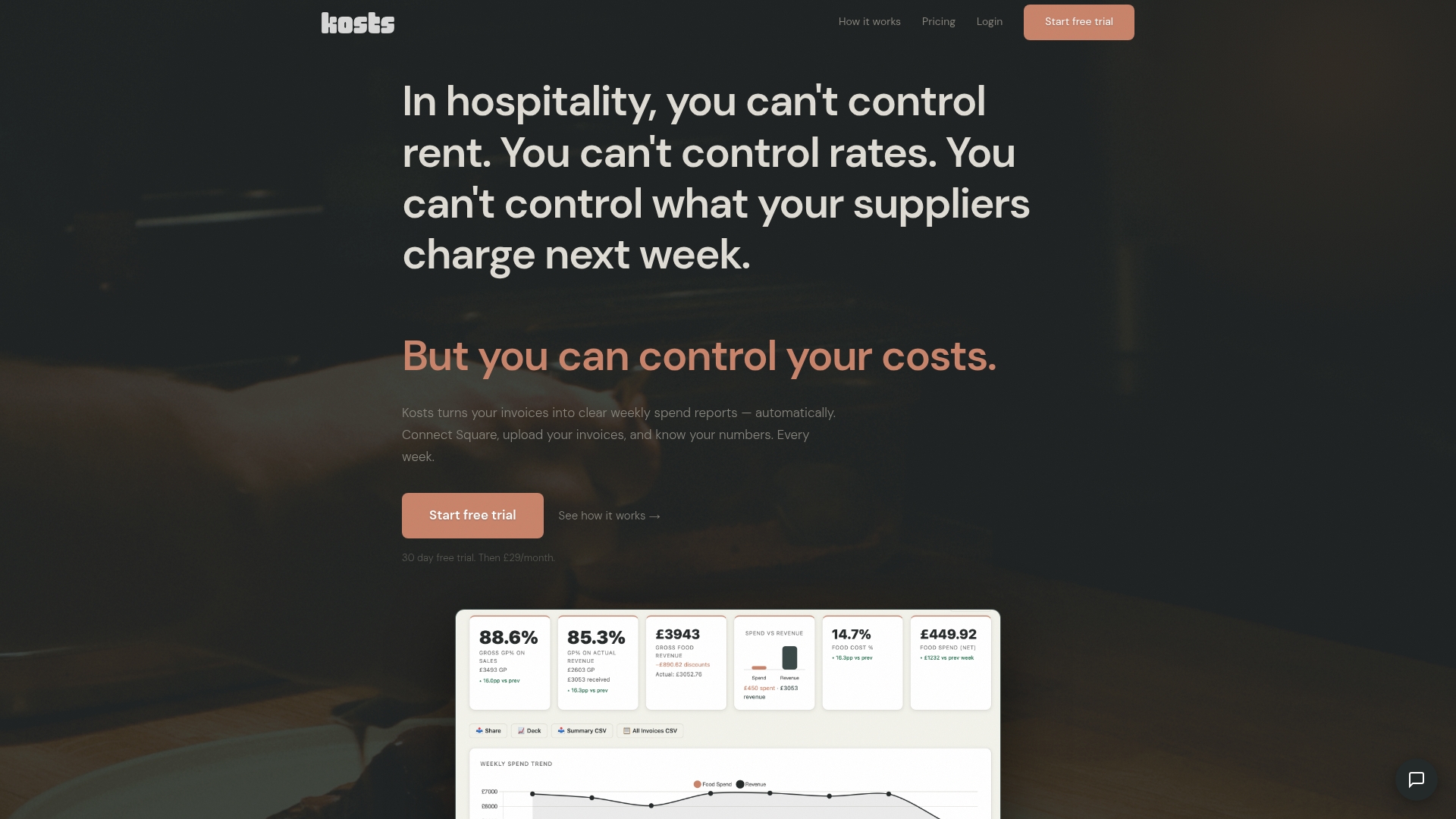
The Kosts app was built by a working chef specifically for independent UK restaurants. You can upload invoices by photo, PDF, or email forwarding, and the platform automatically extracts supplier, item, category, and cost data. It connects with Square and Xero to pull in your revenue automatically, so your food cost percentage is always up to date without any manual calculation. The dashboard gives you weekly, monthly, and quarterly breakdowns by supplier and category, and you can export reports for your accountant in seconds. If you want to see how it fits your operation, the food cost checklist is a great starting point, and Kosts offers a 30-day free trial with no commitment required.
Frequently asked questions
What is the most accurate way to track food costs in a small UK restaurant?
The most accurate method combines regular inventory counts with automated tracking apps that capture all purchases and waste, removing the human error that manual records introduce.
How often should I review food costs to stay on track?
Weekly reviews are standard practice for well-run restaurants, as they allow you to catch overspending or waste issues before they compound into a monthly problem.
What are common mistakes in restaurant food cost tracking?
The most frequent mistakes are not recording all purchases, ignoring wastage, and relying on outdated manual methods that are prone to missed entries and calculation errors.
Is automated food cost tracking expensive?
Modern apps are affordable for independent operators, and digital tools provide strong value by saving hours of admin time each week while delivering more accurate data than manual alternatives.