
Rising ingredient prices and unpredictable supplier costs leave many independent restaurant owners watching their margins shrink month after month. Without a clear system to track and analyse food costs, you're essentially running your kitchen blind, unable to spot waste, control portions, or identify which dishes actually make money. This guide walks you through practical steps to analyse your food costs effectively, from gathering the right data to implementing controls that protect your bottom line and boost profitability.
Table of Contents
- Key Takeaways
- Preparing to analyse your food costs
- How to analyse food costs step by step
- Verifying food cost analysis and optimising menu profitability
- Discover Kosts app to simplify your food cost analysis
- How to analyse food costs: frequently asked questions
Key Takeaways
| Point | Details |
|---|---|
| Inventory tracking | Establish a regular stock count schedule and record opening stock, purchases and closing stock to determine total food cost for each period. |
| Standardised recipes | Document every ingredient with precise quantities and current supplier prices to ensure accurate cost per portion. |
| Waste and portions | Include typical waste percentages and standardise portion sizes to reduce costing variability and protect margins. |
| Digital tools | Use purpose built software to automate invoice processing, link supplier pricing, and flag cost spikes for timely corrections. |
Preparing to analyse your food costs
Successful food cost analysis starts long before you run calculations. You need reliable data, standardised recipes, and clear systems to capture every pound spent in your kitchen.
Start by establishing a regular inventory tracking schedule. Weekly counts work best for high-volume operations, whilst monthly tracking suits smaller establishments with stable turnover. Record every delivery, note invoice amounts, and track what leaves your storeroom. This consistency creates the baseline data you'll need for accurate analysis.
Recipe costing forms the second pillar of preparation. Document every ingredient in each dish, including exact quantities and current supplier prices. Factor in yield percentages and typical waste rates of 5-10% when calculating true costs per portion. A dish that looks profitable on paper can drain margins if you ignore trim loss and prep waste.
Your toolkit matters as much as your data. Spreadsheets work for basic tracking, but they demand manual updates and leave room for calculation errors. Purpose-built software automates invoice processing, links directly to supplier pricing, and flags unusual cost spikes instantly. Choose tools that match your operation's complexity and your team's technical comfort level.
Organise your preparation with this essential data framework:
| Data source | Update frequency | Purpose |
|---|---|---|
| Supplier invoices | Every delivery | Track actual spending and price changes |
| Inventory counts | Weekly or monthly | Calculate usage and identify shrinkage |
| Recipe specifications | Quarterly review | Maintain accurate per-dish costs |
| POS sales data | Daily export | Link costs to revenue for percentage calculations |
Pro tip: Standardise portion sizes across all recipes and train every kitchen team member on exact measurements. A chef who eyeballs quantities or adds "a bit extra" creates costing variability that compounds across hundreds of services. Invest in proper scales, measuring tools, and clear portion guidelines.
Establishing a streamlined cost control workflow eliminates guesswork and creates accountability. When your team knows exactly what to measure and when to measure it, data quality improves dramatically.
Gather current pricing from your top suppliers. Food inflation continues to impact costs, so last quarter's prices won't reflect today's reality. Update your recipe costings with current figures before running any analysis, otherwise you're making decisions based on outdated information.
With solid preparation complete, you're ready to execute the actual analysis process.
How to analyse food costs step by step
Analysing food costs effectively requires a systematic approach that moves from data collection through calculation to identifying specific problem areas.
-
Track inventory and purchases with ruthless consistency. Count stock at the same time each period, using the same method and the same team members when possible. Record opening inventory, add all purchases during the period, subtract closing inventory. This gives you the total food cost for the period. Look for patterns over multiple cycles rather than obsessing over single-week anomalies.
-
Calculate recipe costs for every menu item. Break down each dish into individual ingredients with precise quantities. Multiply ingredient amounts by current unit costs, then add your calculated waste percentage. A chicken dish using 200g of breast meat at £8 per kilo costs £1.60 for that ingredient alone before accounting for trim loss or cooking shrinkage. Sum all ingredient costs to get your true recipe cost, then divide by your menu price to calculate food cost percentage for that specific dish.
-
Identify common cost leaks systematically. Portion creep adds 10% to costs when staff gradually increase serving sizes without adjusting recipes. Spoilage from over-ordering or poor rotation eats margins silently. Theft and unexplained shrinkage create gaps between theoretical and actual usage. Price volatility from suppliers can spike costs overnight if you're not monitoring invoices closely.
-
Conduct yield testing on high-cost ingredients. Weigh products before and after preparation to measure actual loss. That whole salmon might cost £40, but after filleting and trimming, you're left with 60% usable flesh. Your recipe costing must reflect the true cost per portion of finished product, not the raw ingredient price. Test proteins, produce with high trim waste, and any item where prep significantly reduces usable quantity.
-
Implement portion controls and waste reduction measures. Use standardised scoops, ladles, and scales for every dish. Install cameras or supervision during prep to catch over-portioning. Train front-of-house staff to ask about dietary restrictions before plating to reduce returned dishes. Create a waste log where kitchen staff record what's thrown away and why, turning invisible losses into visible data you can address.
Pro tip: Run weekly cost awareness training with your kitchen team. Share the actual cost of ingredients they use daily and explain how waste impacts everyone's job security. When staff understand that the salmon fillet they just binned represents an hour of labour costs, behaviour changes naturally.
Monitor your automated systems regularly to catch data entry errors or system glitches that skew results. Even the best cost control workflow needs human oversight to maintain accuracy.
These steps generate the raw data you need, but numbers alone don't improve profitability. The next phase involves verifying your results and using them strategically.
Verifying food cost analysis and optimising menu profitability
Raw food cost percentages mean little without context and verification. Your analysis only becomes valuable when you check accuracy, benchmark against standards, and use insights to reshape your menu strategy.
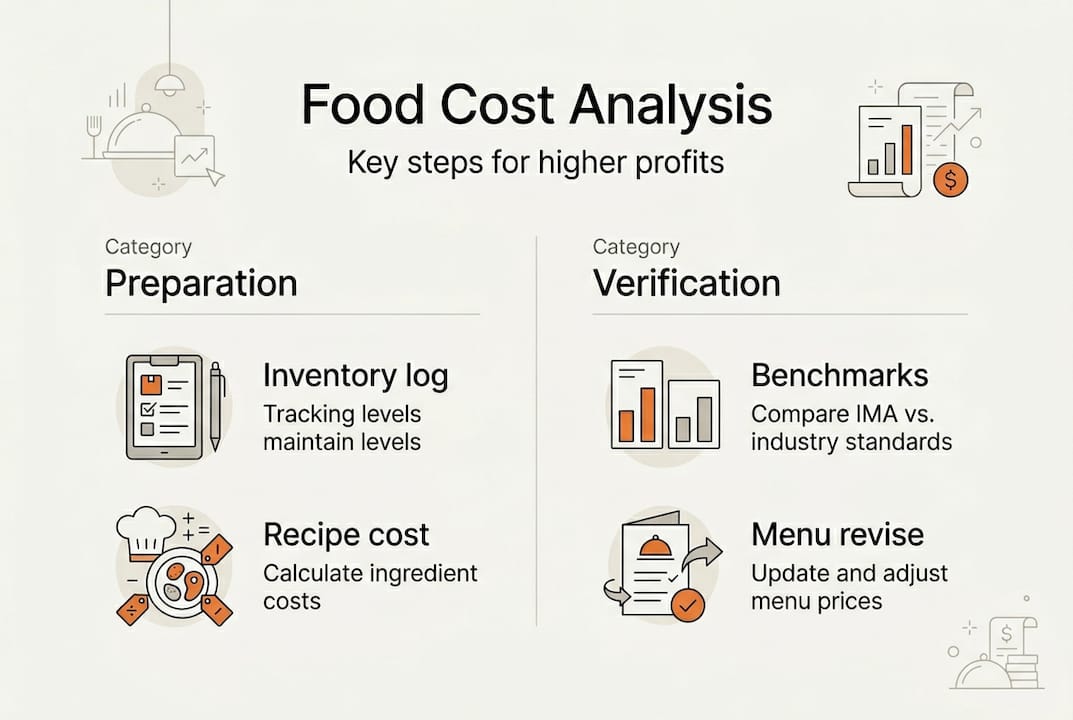
Start verification by comparing your calculated food cost percentage against industry benchmarks and your historical performance. Independent restaurants typically target 28-35% food costs depending on cuisine type and service style. If your calculation shows 42%, either your analysis contains errors or you have serious cost control issues. Cross-check your inventory counts, review invoice entries, and confirm your revenue figures match actual sales.

External factors constantly shift the baseline. Food inflation ran 6-9% in 2024, and 91% of restaurant leaders reported higher costs continuing into 2025. Adjust your targets accordingly rather than holding yourself to pre-inflation standards that no longer reflect market reality.
Compare different tracking approaches to find what works for your operation:
| Method | Accuracy | Time investment | Best for |
|---|---|---|---|
| Manual spreadsheets | Moderate (prone to entry errors) | High (4-6 hours weekly) | Very small operations with simple menus |
| Invoice scanning apps | High (automated extraction) | Low (30 minutes weekly) | Independent restaurants seeking efficiency |
| Full POS integration | Very high (real-time sync) | Minimal (automated) | Multi-site operations needing consolidated reporting |
| Hybrid tracking | Variable (depends on execution) | Moderate (2-3 hours weekly) | Restaurants transitioning to digital systems |
Menu engineering transforms cost data into strategic action. Categorise every dish by profitability (high or low margin) and popularity (high or low sales volume). Your "stars" are high-margin dishes that customers order frequently. These deserve prominent menu placement, staff recommendations, and marketing focus. "Plodders" are low-margin items that sell poorly. Consider removing them entirely or repositioning them as premium specials with higher prices.
Real results prove the approach works. Restaurants using structured cost control tactics report measurable improvements. One case study documented a reduction from 36-37% food costs down to 28% within eight weeks through systematic analysis and controls. Another operator achieved a 2% gross profit increase and 3% food cost reduction in three months by implementing digital tracking.
Verification best practices to catch errors:
- Run calculations twice using different methods or team members
- Spot-check high-value invoices against actual deliveries received
- Compare theoretical usage (recipes x sales) against actual usage (inventory method)
- Review outlier weeks where costs spike or drop unexpectedly
- Validate POS sales data against bank deposits and payment processor reports
Adjust for price volatility by tracking supplier costs weekly rather than assuming stable pricing. When your chicken supplier raises prices 15%, your recipe costs and menu prices need immediate updates. Waiting until your quarterly review means weeks of eroded margins.
Focus resources on your most profitable dishes. If your signature burger delivers 68% gross profit whilst your pasta special barely breaks 45%, train staff to upsell the burger. Feature it in social media content. Consider slight price increases on low-margin items or recipe reformulations using less expensive ingredients.
Digital tools eliminate much of this manual verification work whilst improving accuracy. The right software flags unusual patterns, automates calculations, and provides real-time visibility into cost trends.
Discover Kosts app to simplify your food cost analysis
Managing food costs manually consumes hours each week and leaves room for costly errors. Kosts app automates invoice processing, inventory tracking, and cost calculations so you can focus on running your restaurant rather than wrestling with spreadsheets.
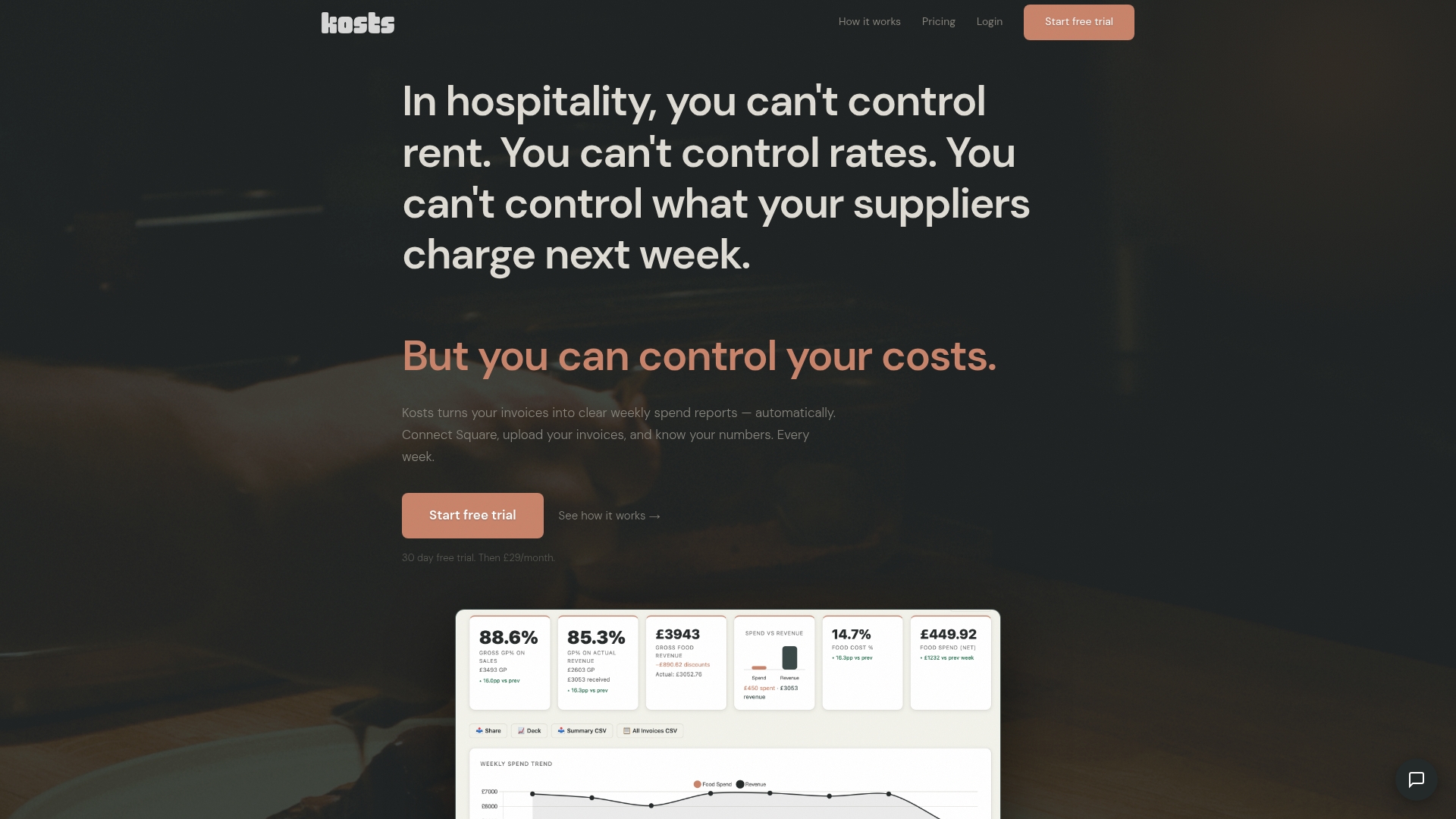
The platform extracts supplier details, item costs, and category data automatically from photos, PDFs, or forwarded emails. Integration with Square and Xero syncs your revenue data, giving you real-time food cost percentages and gross profit insights without manual entry. Users report measurable improvements within weeks of implementation.
Key benefits that save time and boost margins:
- Automated invoice scanning eliminates data entry errors
- Weekly spend reports highlight cost trends before they damage profits
- Recipe costing tools factor in waste and yield automatically
- Team access lets kitchen managers and owners collaborate on cost control
- Export functionality integrates with existing accounting workflows
Built by a working chef who understands restaurant operations, Kosts offers a 30-day free trial with straightforward monthly pricing. It's designed specifically for independent UK restaurants seeking practical cost control workflow improvements without enterprise software complexity.
How to analyse food costs: frequently asked questions
What is food cost percentage and how do I calculate it?
Food cost percentage measures how much of your revenue goes towards ingredients. Calculate it by dividing total food costs by total food sales, then multiply by 100. If you spent £3,000 on ingredients and generated £10,000 in food sales, your food cost percentage is 30%.
How often should I update my recipe costing?
Update recipe costs quarterly at minimum, or immediately when major suppliers change prices. Volatile ingredients like seafood or seasonal produce need monthly reviews. Waiting too long means your menu prices no longer reflect actual costs, silently eroding margins.
What software can help me analyse food costs effectively?
Purpose-built platforms like Kosts automate invoice processing and cost tracking specifically for restaurants. They integrate with POS systems and accounting software to provide real-time visibility. Generic accounting tools lack the recipe costing and menu engineering features restaurants need for detailed cost control workflows.
How can staff training reduce food cost waste?
Trained staff understand portion sizes, proper storage rotation, and prep techniques that minimise trim loss. They recognise when they're over-portioning and catch spoilage before it happens. Weekly cost awareness sessions that share actual ingredient costs create accountability and change behaviour naturally.
What are some quick tips to prevent portion creep in a busy kitchen?
Use standardised measuring tools like scoops and scales rather than eyeballing quantities. Plate dishes using photos as guides so every server knows the correct presentation. Conduct random plate checks during service to catch over-portioning immediately. Make portion control part of your training checklist for every new kitchen team member.