

Running an independent restaurant in the UK means walking a tightrope between delivering exceptional food and keeping costs under control. With food prices fluctuating, labour expenses climbing, and margins tighter than ever, many owners find themselves drowning in invoices and spreadsheets, always one step behind their actual spending. Real-time expense management isn't just a nice-to-have anymore, it's the difference between thriving and merely surviving. This guide walks you through the complete expense management process, from understanding your cost structure to implementing systems that give you the visibility and control you need to protect your profits.
Table of Contents
- Key takeaways
- Understanding your restaurant's expense categories and benchmarks
- Preparing for effective expense management
- Executing real-time expense tracking and control
- Verifying expense accuracy and managing common pitfalls
- How Kosts can simplify your expense management
- Frequently asked questions
Key Takeaways
| Point | Details |
|---|---|
| Expense category mix | Understand food and beverage, labour and overhead costs to identify where money leaks and where to optimise. |
| Prime cost focus | Keeping prime costs at sixty to sixty five per cent protects profit margins. |
| Automated systems save time | Automated invoice processing and real time inventory tracking can reduce admin work by up to ninety per cent. |
| Thirteen week forecasting | Adopt a thirteen week rolling forecast to align budgeting with weekly hospitality patterns and seasonal swings. |
| Weekly KPI reviews | Track key KPIs weekly such as daily food cost percentage, labour cost per cover and waste to spot problems early. |
Understanding your restaurant's expense categories and benchmarks
Before you can control costs, you need to know what you're controlling. Restaurant expenses fall into three primary buckets: food and beverage costs, labour expenses, and overheads. Each category behaves differently and requires distinct management approaches. Food costs fluctuate with supplier prices and waste levels. Labour responds to scheduling efficiency and productivity. Overheads like rent and utilities remain relatively stable but still need monitoring.
The most critical metric for restaurant profitability is prime cost, which combines your food and labour expenses. Food and beverage costs typically represent 28-35% of revenue, labour 25-35%, and overheads 10-18%, with prime costs targeted at 60-65%. When your prime cost creeps above 65%, your net profit margin gets squeezed dangerously thin. Independent restaurants operating efficiently usually see gross profit margins between 60-70% and net margins of 3-9%, depending on concept and location.
Understanding these benchmarks helps you identify problem areas quickly. If your food cost percentage sits at 38% while the industry average is 32%, you've found your first target for improvement. Track each category separately rather than lumping everything together. This granular approach reveals exactly where money flows and where it leaks. A streamlined cost control workflow starts with knowing your numbers inside out.
Pro tip: Review your expense percentages weekly rather than monthly. Weekly reviews catch problems while they're still small and fixable, not after they've eaten into an entire month's profits.
Preparing for effective expense management
Successful expense management requires the right foundation. You can't manage what you don't measure, and you can't measure efficiently without proper systems. Start by selecting expense management tools designed specifically for independent restaurants, not generic accounting software that treats you like any other business. Look for platforms that understand hospitality-specific challenges like recipe costing, portion control, and supplier price fluctuations.
Establish 13-week budgeting cycles instead of traditional monthly ones. Hospitality operates on weekly patterns, with weekends driving revenue and midweek periods requiring different staffing and purchasing strategies. A 13-week rolling forecast aligns your financial planning with operational reality. This approach helps you anticipate seasonal swings, plan for events, and adjust purchasing before problems arise.

Set up automated systems for invoice processing and inventory tracking. Automated invoice processing and real-time inventory tracking reduce admin work by up to 90% and food waste by 21%. Manual data entry doesn't just waste time, it introduces errors that compound into significant financial discrepancies. When invoices flow automatically from suppliers into your expense tracking system, you eliminate transcription mistakes and gain immediate visibility into spending patterns.
Focus on tracking key performance indicators daily or weekly rather than waiting for month-end reports. Essential KPIs include:
- Daily food cost percentage
- Labour cost per cover
- Waste tracking by category
- Supplier spend by vendor
- Gross profit margin trends
Implement portion control standards and supplier negotiation protocols early in your expense management journey. Standardised recipes with precise measurements prevent over-portioning, which silently drains profits. Regular supplier reviews ensure you're getting competitive pricing and identify opportunities to consolidate orders or switch vendors for better terms.
| Preparation element | Time investment | Impact on cost control |
|---|---|---|
| Automated invoice processing | 2-3 hours setup | Eliminates 90% of manual data entry |
| 13-week budgeting cycle | 4 hours quarterly | Aligns planning with operational reality |
| Portion control standards | 6-8 hours initial | Reduces food waste by 15-20% |
| Supplier review process | 2 hours monthly | Captures 3-5% savings through negotiation |
Pro tip: When setting up automated systems, start with your highest-volume suppliers first. You'll see immediate benefits from automating the invoices that consume most of your admin time, building momentum for rolling out the system to smaller vendors.
Executing real-time expense tracking and control
Real-time tracking transforms expense management from reactive firefighting to proactive control. Synchronise your point-of-sale system with expense tracking tools to monitor costs as they happen, not weeks later when it's too late to adjust. This integration provides live visibility into your actual food cost percentage, comparing what you're selling against what you're spending as transactions occur.
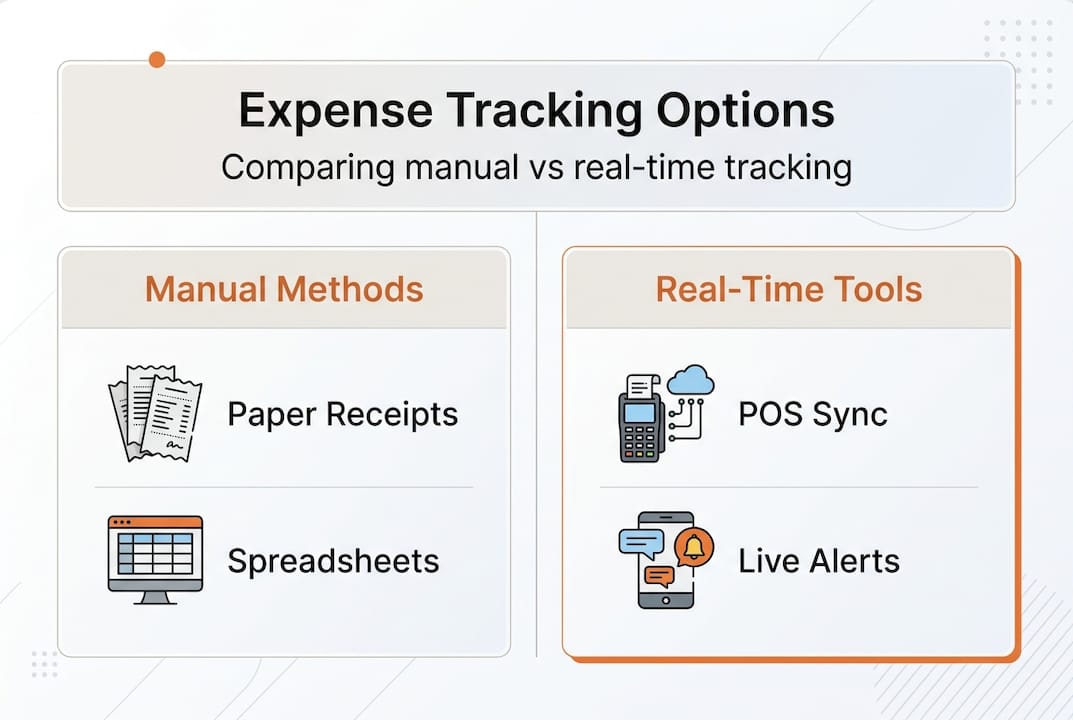
Menu engineering becomes far more effective with real-time data. You can quickly identify which dishes deliver strong margins and which ones drain profits. Adjust menu mix by promoting high-margin items, redesigning expensive dishes, or removing persistent underperformers. Recipe costing tools within modern platforms calculate exact dish costs based on current ingredient prices, alerting you when supplier price increases threaten profitability.
Implement these execution steps for maximum control:
- Review daily flash reports showing revenue, prime cost, and key variances
- Conduct weekly deep dives into supplier spending and category trends
- Monitor portion control through waste tracking and plate checks
- Adjust purchasing based on actual usage patterns, not assumptions
- Respond immediately to price alerts from suppliers
Regularly review and negotiate supplier terms. Prices change constantly in hospitality, and loyalty to vendors who consistently raise prices without notice costs you money. Track price movements across your top 20 suppliers and initiate conversations when increases outpace market averages. Many suppliers offer better terms to customers who demonstrate they're actively monitoring costs.
Portion control and waste monitoring deserve daily attention. Train kitchen staff to measure accurately and track waste at each service. Common waste sources include over-portioning, spoilage from over-ordering, and trim waste from poor prep techniques. When you measure waste daily, patterns emerge that reveal training opportunities or purchasing adjustments.
Platforms like Jelly provide live dish costing, price alerts, and POS synchronisation, saving independents 58 hours weekly and improving gross profit by 2-3%. These tools pay for themselves quickly through time savings alone, before counting the profit improvements from better decisions.
| Tracking approach | Admin time | Accuracy | Decision speed |
|---|---|---|---|
| Manual spreadsheets | 15-20 hours/week | 75-80% (high error rate) | 2-4 weeks lag |
| Basic accounting software | 8-12 hours/week | 85-90% | 1-2 weeks lag |
| Automated real-time platforms | 1-2 hours/week | 95-98% | Same-day visibility |
The comparison is stark. Manual methods consume enormous time while delivering delayed, error-prone data. Real-time platforms provide accurate information when you can still act on it. That responsiveness means catching a supplier price increase before it affects your entire week's purchasing, or identifying a portioning issue during service rather than discovering it in next month's variance report.
Verifying expense accuracy and managing common pitfalls
Even with automated systems, verification prevents costly mistakes from slipping through. Conduct quarterly audits focusing on high-risk areas: waste tracking accuracy, VAT treatment on staff meals and benefits, and expense categorisation. These audits catch systematic errors before they become expensive problems. Compare your recorded waste against actual bin weights, verify VAT calculations on mixed transactions, and ensure expenses land in correct categories for accurate reporting.
Seasonal fluctuations hit independent restaurants hard. Summer tourism might triple your revenue while winter slumps test your cash reserves. Maintain seasonal cash buffers equivalent to 4-6 weeks of operating expenses to weather slow periods without panic. Build these buffers during peak seasons by setting aside a percentage of surplus cash rather than spending every profitable month's gains.
Avoid the month-end reporting trap. Monthly financial statements arrive too late for operational decisions. By the time you see February's results in mid-March, you've already made most of March's purchasing and staffing decisions. Weekly flash reports showing revenue, prime cost, and critical variances enable course corrections while they still matter. You can adjust this week's orders based on last week's performance, not last month's ancient history.
Common pitfalls to actively manage:
- Manual data entry errors causing 5-10% hidden losses
- VAT mistakes on staff perks and mixed-rate sales
- Ignoring seasonal demand patterns in purchasing
- Over-relying on supplier relationships instead of competitive pricing
- Failing to track and reduce food waste systematically
Hidden losses of 5-10% often arise from manual entries, whilst VAT errors on staff perks and seasonal cost buffers represent common pitfalls that drain profits silently. These aren't dramatic failures, they're slow leaks that compound into serious financial damage over time.
Train your team on portion control and waste reduction. Kitchen staff directly impact your food costs through their daily decisions. A chef who eyeballs portions instead of measuring adds 10-15% to your food cost without realising it. Regular training sessions on standardised recipes, proper measuring techniques, and waste consciousness create a culture of cost awareness that protects margins.
Pro tip: Create a simple checklist for weekly expense verification covering your top five cost drivers. Spend 30 minutes each week reviewing these items rather than waiting for quarterly audits. Early detection of problems saves far more than the time invested in checking.
"The restaurants that succeed long-term aren't necessarily the ones with the best food or the trendiest concepts. They're the ones that understand their numbers and respond quickly when costs drift off target. Real-time visibility turns expense management from a dreaded chore into a competitive advantage."
How Kosts can simplify your expense management
If you're still wrestling with spreadsheets or waiting weeks for financial clarity, there's a better way. Kosts is built specifically for UK independent restaurants, turning your invoices into clear, automated weekly spend reports that show exactly where your money goes. Upload invoices by photo, PDF, or email, and the platform's AI extracts supplier, item, and cost data automatically. No more manual entry, no more transcription errors.
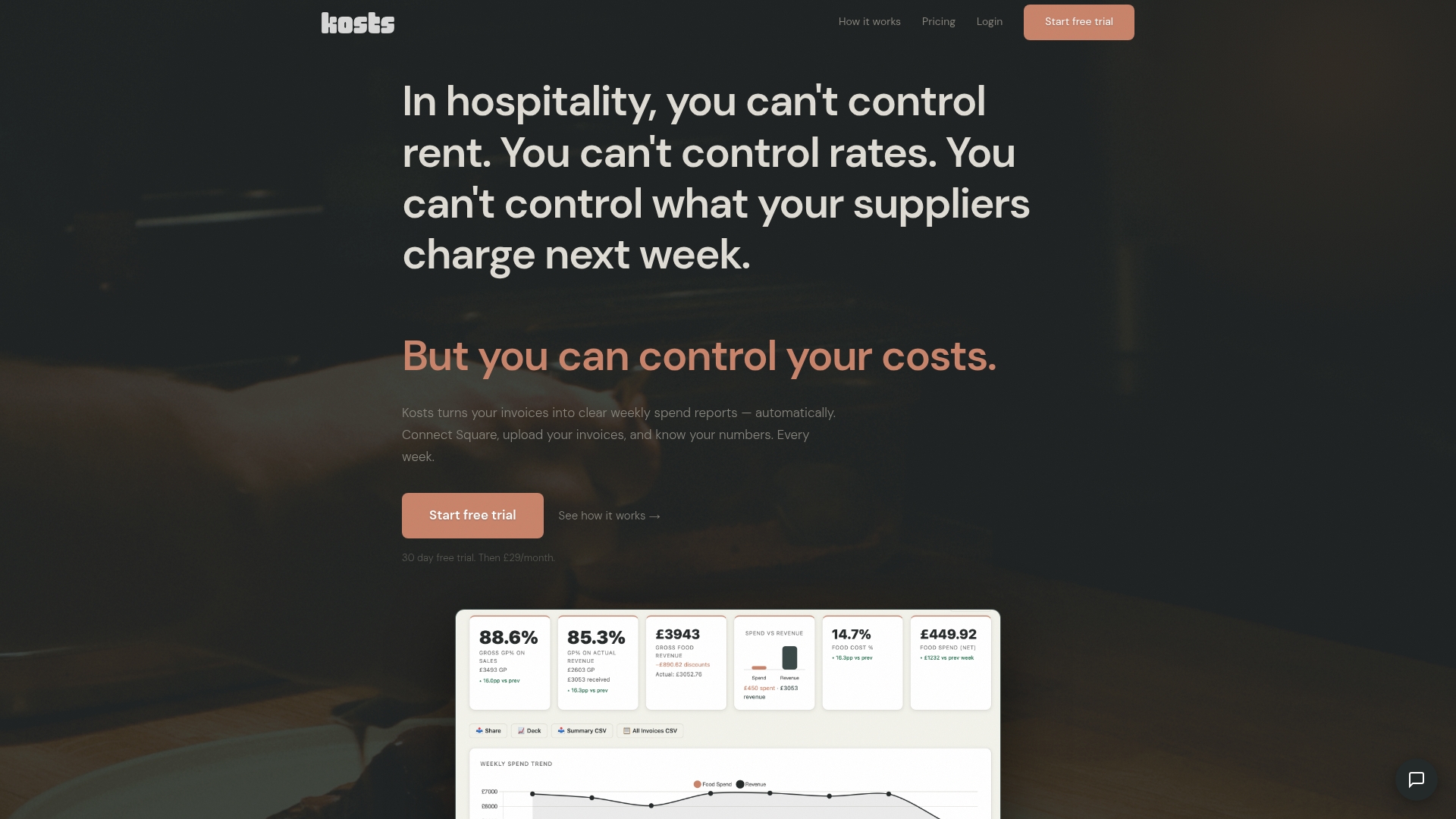
The platform integrates seamlessly with Square and Xero, importing revenue automatically and synchronising your financial data in real time. You get instant visibility into food cost percentage, gross profit, and spending breakdowns by supplier and category. Built by a working chef who understands restaurant realities, Kosts focuses on simplicity and relevant features like team access and report exports. The pricing is straightforward with a 30-day free trial and predictable monthly subscription, making it accessible for independents who need professional cost control without enterprise complexity or spreadsheet headaches.
Frequently asked questions
What are the main expense categories for restaurant cost control?
Food and beverage, labour, and overheads form the three primary expense categories for restaurants. Prime cost, combining food and labour, should ideally stay under 65% of revenue to maintain healthy profitability. Tracking these categories separately reveals exactly where your money flows and where problems emerge, enabling targeted improvements rather than broad cost-cutting that might damage quality or service.
How often should I review my restaurant expenses for best results?
Weekly reviews deliver the best results for restaurant expense management, with daily monitoring of critical metrics like food cost percentage providing even tighter control. Monthly reviews arrive too late for operational decisions, hiding costly variances until they've already damaged your margins. Weekly flash reports catch problems while they're still small and actionable, letting you adjust purchasing and operations before issues compound.
What are common pitfalls in managing restaurant expenses?
Manual data entry creates hidden losses of 5-10% through transcription errors and missed invoices. VAT errors on staff meals, drinks, and benefits trigger compliance issues and unexpected tax bills. Ignoring seasonal fluctuations leads to cash flow crises during slow periods and missed opportunities during peak seasons. Many restaurants also over-rely on supplier relationships, paying loyalty premiums instead of regularly reviewing competitive pricing.
What real-time tools can help independent restaurants manage expenses?
Platforms like Jelly and Xero-integrated applications provide live dish costing, supplier price alerts, and POS synchronisation tailored for hospitality operations. These affordable solutions save substantial time through automation whilst improving profitability through faster, better-informed decisions. Look for tools designed specifically for independent restaurants rather than generic accounting software, as hospitality-specific features like recipe costing and portion control tracking deliver far more value. A comprehensive cost control workflow integrates these tools into your daily operations seamlessly.