

TL;DR:
- Food waste averages 22% in UK restaurants, leading to significant profit loss.
- Effective monitoring involves real-time tracking of costs, waste, portion sizes, and variance analysis.
- Digital tools enhance accuracy and save time, helping independents control costs and improve margins.
The average UK restaurant wastes 22% of food purchased each year. That is not a rounding error or an industry quirk. It is real money leaving your business quietly, week after week, hidden inside invoices, portion sizes, and bins full of spoilage. Most independent operators treat food cost monitoring as an accounting task to revisit at year end. But by then, the damage is done. This guide explains what proper monitoring actually involves, where the silent profit drains are hiding, and how to build a practical system that protects your margins without adding hours to your working week.
Table of Contents
- What food cost monitoring really means
- The hidden profit drain: ingredient price swings, waste, and yield loss
- Making monitoring practical: digital tools vs manual tracking
- Success in action: real-world strategies to cut food costs
- A fresh perspective: the overlooked advantage of monitoring food costs
- Next steps: streamline your food cost monitoring
- Frequently asked questions
Key Takeaways
| Point | Details |
|---|---|
| Track to save money | Monitoring food costs helps UK restaurants recover wasted profit and improve margins. |
| Digital tools cut waste | Using automated tracking is proven to reduce waste and boost efficiency versus manual methods. |
| Small changes compound | Consistent, disciplined cost tracking produces bigger gains than menu overhauls or major cuts. |
| Weekly reviews prevent loss | Reviewing food costs weekly allows quick correction of price hikes, portion drift, or waste spikes. |
What food cost monitoring really means
Food cost monitoring is not simply checking your invoices once a month. It means tracking every pound you spend on ingredients, measuring how much of that spend actually reaches a paying customer, and understanding the gap in between. That gap is where your profit quietly disappears.
There are two persistent myths worth addressing head on. The first is that food cost monitoring is the accountant's job. It is not. Your accountant reconciles figures after the fact. Monitoring happens in real time, in the kitchen, on the pass, and at the point of ordering. The second myth is that experienced operators can rely on gut feel. They cannot. Gut feel does not catch a 5p increase per kilo on chicken breast, repeated across 200 covers a week.
Every menu item, every order quantity, and every portion size contributes to your true cost picture. Missing any one of them creates a distorted view of profitability. A dish that looks profitable on paper can destroy your margins in practice if yield is poor or portions drift upward over time.
Understanding prime cost is essential here. Prime cost combines your food spend with your labour costs, and for a healthy UK independent, prime cost should sit between 55 and 65% of revenue. With margins already tight, food monitoring is not optional. It is the mechanism that keeps prime cost from creeping beyond that threshold.
The most useful monitoring approach tracks both actual costs (what you really spent) and theoretical costs (what you should have spent based on recipes and portions). The difference between the two is called variance, and variance tells you exactly where to look for problems. You can read more about this in our guide to tracking food costs tips and in the food cost control checklist for practical starting points.
Key elements of effective food cost monitoring:
- Logging every purchase invoice by supplier, item, and category
- Recording actual usage against theoretical recipe costs
- Measuring waste at prep, cooking, and service stages
- Reviewing portion sizes regularly against standard recipes
- Comparing weekly spend against revenue to calculate food cost percentage
Pro Tip: Run both actual and theoretical cost reports side by side each week. Any variance above 3% is worth investigating immediately.
The hidden profit drain: ingredient price swings, waste, and yield loss
Now that you know the scope of food cost monitoring, let us look at the less obvious profit drains that monitoring helps you catch before they become serious.
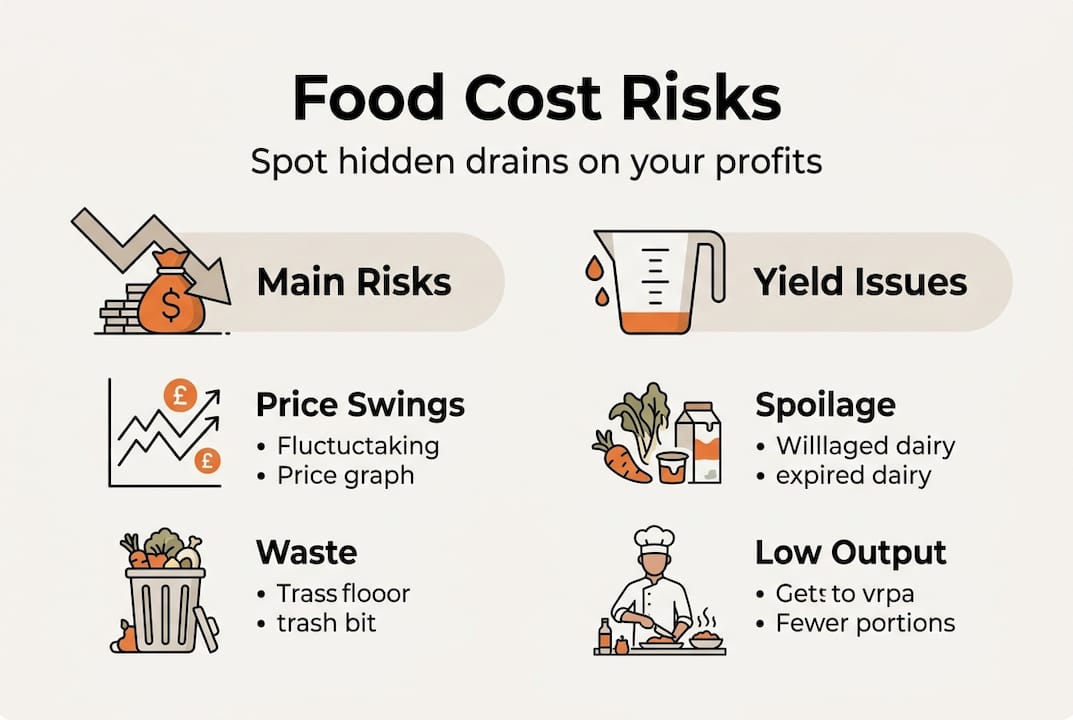
Ingredient prices in the UK have been volatile for several years. Supply chain disruptions, seasonal shortages, and energy cost pressures all feed into what you pay per kilo. The problem is not the price increase itself. The problem is when operators do not notice it until margins have already collapsed.
Spoilage is the other silent killer. When 22% of food purchased is wasted, a significant portion of that waste is avoidable with better ordering discipline and stock rotation. Buying too much because you are uncertain about demand is a costly habit that monitoring can break.
Yield loss is perhaps the least discussed issue. Yield refers to how much usable product you get after trimming, cooking, and portioning. A chicken breast bought at £4 per kilo may only yield 70% usable meat after prep. If your recipe costing does not account for that, every dish is underpriced from the start. Ignoring yield loss alone can leave a 12% profit gap in your operation.
For a clearer picture of how these risks stack up, see how analysing food costs can surface these issues systematically.
| Profit drain | Typical impact | Monitoring fix |
|---|---|---|
| Food waste (22% average) | Up to 8% margin loss | Weekly waste logging |
| Yield loss (untracked) | Up to 12% profit gap | Recipe yield factors |
| Ingredient price spikes | 3 to 6% cost creep | Supplier price alerts |
| Portion inconsistency | 2 to 4% per dish | Standardised recipes |
Common warning signs your costs are slipping:
- Food cost percentage rising without a menu price change
- Gross profit falling despite steady covers
- Supplier invoices increasing without a formal notification
- Stock counts not matching purchase records
"Yield loss alone closes a 12% profit gap" when left unaddressed in restaurant operations.
Making monitoring practical: digital tools vs manual tracking
Understanding the risks is only part of the journey. Choosing the right approach for your operation is the next step.
Manual tracking using spreadsheets is still common among independents. It costs nothing upfront and feels familiar. But manual cost tracking takes on average 28 minutes per dish to complete accurately, and even then it tends to miss incremental cost creep. A 2p increase on one ingredient, repeated across 15 dishes, adds up to a meaningful margin shift that a spreadsheet updated fortnightly will never catch in time.
Digital tools change this equation considerably. Automation removes the manual data entry burden, flags anomalies in real time, and produces consistent reports without relying on someone remembering to update a file. Digital tools reduce food waste by 21% on average, which for a busy independent represents a substantial saving each month.
| Feature | Manual tracking | Digital tools |
|---|---|---|
| Time per update | High (28+ min per dish) | Low (automated) |
| Accuracy | Variable | Consistently high |
| Cost creep detection | Slow or missed | Real time |
| Reporting consistency | Depends on operator | Automated weekly |
| Savings potential | Limited | Up to 21% waste reduction |
For busy independents, the best starting point is not the most feature-rich platform. It is the one you will actually use every week. Look for automated food cost tracking tools that integrate with your existing systems and require minimal setup time. A good cost control workflow built around digital tools pays for itself quickly.
Steps to move from manual to digital tracking:
- Audit your current tracking method and identify where data falls through the gaps
- Choose a tool that connects to your invoicing and accounting systems
- Upload your existing supplier invoices to build a baseline cost picture
- Set a weekly review time, ideally the same day each week
- Compare actual spend against your revenue figures to calculate food cost percentage
Pro Tip: Schedule a fixed 30-minute weekly review of your cost data. Catching a 2% variance early is far cheaper than discovering a 10% problem at month end.
Success in action: real-world strategies to cut food costs
With a clear idea of tools and risk points, let us look at how UK independents are turning cost monitoring into genuine profit.
Menu engineering is one of the highest-impact strategies available. This means analysing which dishes are both popular and profitable, then promoting those while quietly retiring or repricing the underperformers. Seasonal sourcing, menu engineering, and cross-utilisation of ingredients are consistently the highest-impact techniques operators use to manage food costs in 2026.
Cross-utilisation means using the same ingredient across multiple dishes. A single cut of beef might appear in a starter, a main, and a staff meal. This reduces over-ordering, minimises waste, and improves yield efficiency across the menu. Independents who apply seasonal cross-utilisation see up to 8% lower food costs compared with those who plan menus without ingredient overlap.
Negotiating with suppliers is another lever that many operators underuse. In high-inflation environments, better data and supplier negotiations deliver more return on investment than cutting portion sizes or reducing quality. When you can show a supplier your purchase history and volume trends, you are in a far stronger position to secure better pricing or payment terms.
Top cost-saving strategies used by UK independents:
- Menu engineering focused on high-margin dishes and sides
- Seasonal ingredient sourcing to reduce price volatility exposure
- Cross-utilisation of key proteins and produce across multiple dishes
- Supplier renegotiation backed by purchase data
- Standardised portion control enforced through recipe cards
For more detail on putting these into practice, explore our proven food cost control strategies and the step-by-step expense tracking process that supports them.
One fast win you can implement this week:
- Pick your three highest-cost ingredients
- Check the last four invoices for each to spot any price movement
- Calculate the yield percentage for each in your current recipes
- Adjust recipe costs to reflect actual yield, not purchase weight
- Review whether menu prices still deliver your target margin
A fresh perspective: the overlooked advantage of monitoring food costs
Most conversations about food cost monitoring focus on cutting waste or tightening portions. That framing misses the bigger opportunity entirely.
The real value of monitoring is informational. When you track costs consistently, you build a dataset that tells you things your competitors simply do not know about their own operations. You know which supplier is quietly raising prices. You know which dish has drifted from its recipe. You know which week of the month your waste spikes and why.
Creative menu ideas rarely outperform this kind of disciplined data collection when it comes to margin improvement. A new seasonal dish might add 1% to your revenue. Closing a 3% variance on your top five dishes adds that much directly to profit, with no marketing spend required.
The independent restaurants that consistently outperform their peers are not necessarily the most creative. They are the most disciplined. They run the same checks every week, review the same reports, and make small corrections before small problems become large ones.
See how financial data drives profits for operators who commit to this approach.
Pro Tip: Run a 30-day monitoring test on just one key ingredient. Track purchase price, yield, and waste weekly. The savings you surface will make the case for doing the same across your entire menu.
Next steps: streamline your food cost monitoring
What gets measured, gets managed. That principle is at the heart of every profitable independent restaurant we have seen. The strategies in this guide work, but they only work if you have a reliable system to collect and review the data consistently.
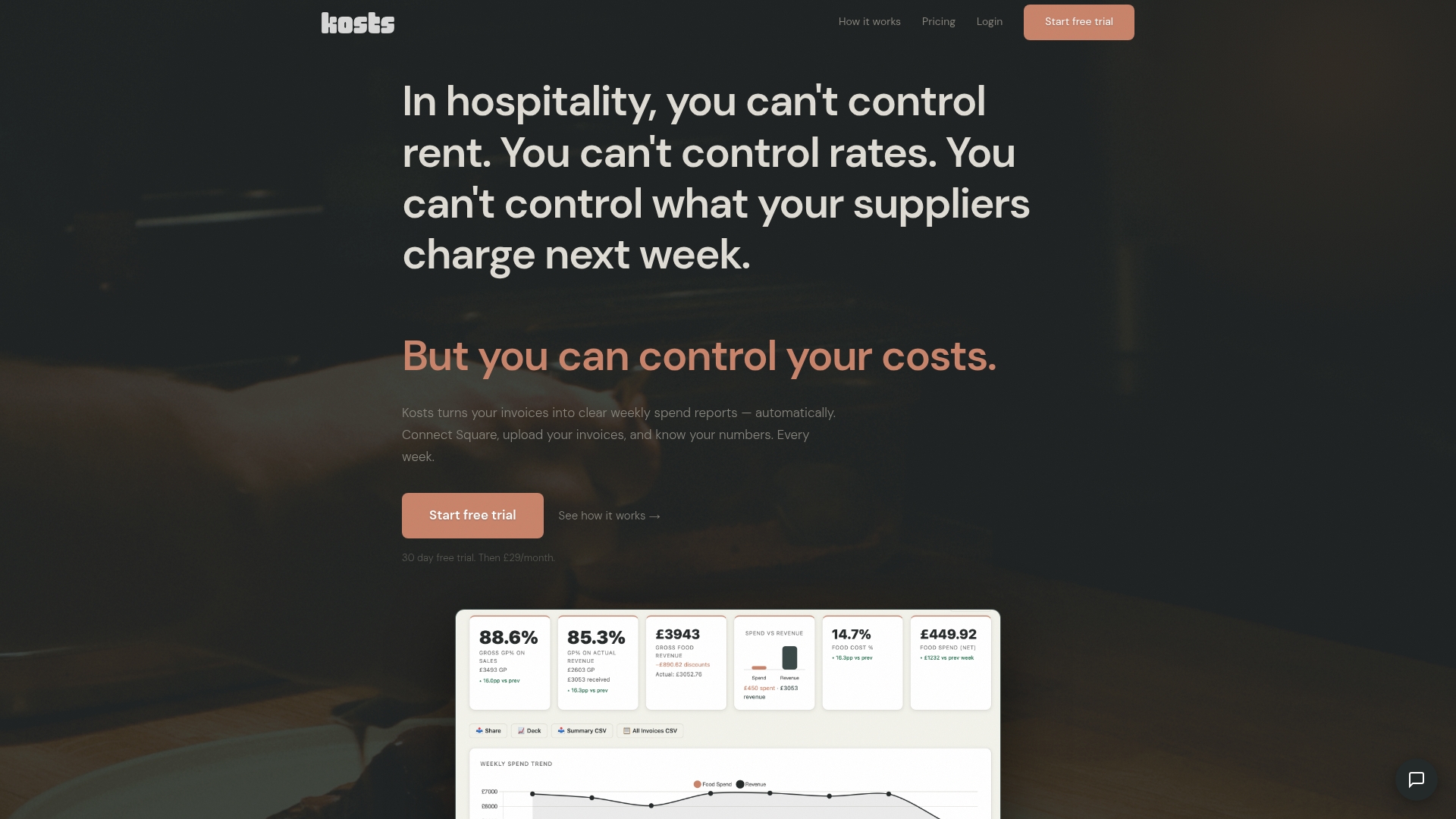
Kosts is built specifically for independent UK restaurants and food businesses. You can upload invoices by photo, PDF, or email, and the platform automatically extracts supplier, item, category, and cost data. Weekly spend reports are generated automatically, giving you a clear food cost percentage and gross profit view without the manual effort. With a 30-day free trial and straightforward monthly pricing, it is the practical next step for any independent ready to take food cost monitoring seriously.
Frequently asked questions
What is a good food cost percentage for UK restaurants?
A profitable UK restaurant typically targets a food cost percentage between 28% and 35% of food sales. This sits within the broader prime cost benchmark of 55 to 65% that includes labour.
How often should a restaurant review its food costs?
Food costs should be reviewed at least weekly. Weekly reviews allow you to catch price changes, waste patterns, and cost creep early, before they compound into a serious margin problem.
Does food cost monitoring really improve profits?
Yes. Consistent monitoring can reduce waste by 21% and close profit gaps of 12% or more by surfacing yield loss and price drift that would otherwise go unnoticed.
What is the easiest way to start monitoring food costs?
The simplest first step is to log every food order and compare it weekly against actual usage and your sales figures. Even a basic weekly review creates immediate visibility.
Should small restaurants invest in digital cost tracking tools?
Yes. Digital tools save time, improve accuracy, and reduce waste by 21% on average, making them a worthwhile investment even for smaller independent operations.