
TL;DR:
- Managing costs effectively is crucial for long-term restaurant profitability beyond just sales.
- Tracking prime, fixed, and variable costs regularly helps identify areas to cut waste and improve margins.
- Using automated tools and weekly reviews enables operators to control expenses and stay competitive.
Running a busy restaurant and watching tables fill up every service can feel like success. But many independent operators discover too late that strong sales do not guarantee a healthy business. Costs that quietly compound in the background — wages, food waste, energy bills, and supplier overcharges — can erode margins faster than any quiet Tuesday. In fact, some of the most customer-loved restaurants in the UK have closed not from lack of footfall, but from a poor grasp of their true operating costs. This guide breaks down every major cost category, shows you how to track and control them, and gives you practical tools to protect your profits long-term.
Table of Contents
- What makes up restaurant operating costs?
- How to track and analyse your costs accurately
- Common cost drivers and how to control them
- Best practices to reduce costs and boost profits
- Why mastering costs is the key competitive advantage
- Get visibility and control with smart cost tools
- Frequently asked questions
Key Takeaways
| Point | Details |
|---|---|
| Know your cost breakdown | Understanding every main expense category is the first step to effective control. |
| Track costs consistently | Regular tracking and review prevent costly surprises and support better decisions. |
| Focus on major drivers | Labour and food wastage offer the biggest savings opportunities for most UK restaurants. |
| Adopt best practices | Weekly reviews, team involvement, and technology help you stay one step ahead. |
| Invest in smart tools | Automation streamlines tracking for better financial management and peace of mind. |
What makes up restaurant operating costs?
Understanding where your money goes is the foundation of every sound financial decision. Restaurant operating costs fall into three broad groups: prime costs, fixed costs, and variable costs.
Prime costs are the big two: cost of goods sold (COGS, meaning food and beverage) and labour. These are the costs most directly tied to your daily output. According to a solid prime cost breakdown, prime costs make up 55-65% of total restaurant costs for most UK operators. That leaves a relatively slim margin to cover everything else.
"Prime costs — cost of goods sold plus labour — typically account for 55-65% of total restaurant revenue. Keeping them within this range is the single most important benchmark for UK restaurant profitability."
Fixed costs stay roughly the same regardless of how busy you are. These include rent, business rates, insurance premiums, and loan repayments. Variable costs shift with trade volume: energy use, disposables, and some staffing elements.
Here is a breakdown of typical cost categories and their average share of revenue for UK independent restaurants:
| Cost category | Typical % of revenue |
|---|---|
| Food and beverage (COGS) | 28-35% |
| Labour (wages, NI, pension) | 25-35% |
| Rent and rates | 5-12% |
| Utilities (gas, electric, water) | 3-6% |
| Insurance | 1-2% |
| Equipment maintenance | 1-3% |
| Marketing and admin | 1-3% |
These ranges vary by concept, location, and service style. A city-centre fine dining room will carry very different rent pressures than a suburban café.
Costs that owners often overlook include:
- Credit card processing fees from card terminals, which can quietly add up to 1-2% of turnover
- Staff meals and wastage that never appear on a formal invoice
- Packaging and disposables that spike during high-volume periods
- Licencing renewals such as premises licences and music licences
- Pest control and deep cleaning contracts billed quarterly
Using budgeting tips designed for UK operators can help you build a realistic baseline and stop surprises from derailing your cash flow.
How to track and analyse your costs accurately
Now that you know what to track, it is crucial to use the right systems to capture every expense. The method you choose matters enormously.
Manual ledgers are low-cost but time-intensive and prone to human error. Spreadsheets offer more flexibility, but they depend on consistent data entry and can become unwieldy as your supplier list grows. Automated software is increasingly accessible for independent operators and delivers the most reliable picture. Tracking costs digitally reduces errors and saves time, enabling owners to spot trends as they emerge.
Common tracking mistakes to avoid:
- Entering invoices days or weeks after receipt, which distorts weekly figures
- Mixing personal and business expenses in the same account
- Failing to reconcile supplier statements against what you actually received
- Ignoring small, recurring charges that seem trivial individually
- Not categorising costs consistently, making comparisons meaningless
Here is a step-by-step process for setting up a reliable digital tracking system:
- Choose your tool. Select software built for hospitality rather than a generic accounting package. Look for invoice scanning, category tagging, and weekly reporting.
- Standardise your categories. Agree on a fixed list (food, beverage, labour, utilities, etc.) and stick to it across every entry.
- Enter data at the point of receipt. Process invoices the same day they arrive, whether by photo upload, PDF, or email forwarding.
- Set a weekly review slot. Block 30 minutes every Monday to review the previous week's spend against your targets.
- Reconcile monthly. Cross-reference your digital records against bank statements and supplier accounts to catch discrepancies.
A well-structured tracking process for higher profits does not need to be complicated. Consistency beats complexity every time. Exploring automated expense tracking options built for UK restaurants can dramatically cut the admin burden.
Pro Tip: Spot-check at least two or three supplier invoices per week against your delivery notes. Overbilling errors are more common than most owners realise, and catching one can save you hundreds of pounds over a year.
Common cost drivers and how to control them
Accurate tracking is only part of the story. Real results come from addressing the roots of major costs. Labour costs and food wastage are the biggest controllable drivers for most UK operators, but they are far from the only ones.
| Cost driver | Control tactic |
|---|---|
| Labour overspend | Use a rota tool tied to forecasted covers |
| Food waste | Implement daily waste logs and portion guides |
| Energy bills | Schedule equipment off-peak and audit usage |
| Supplier price creep | Review invoices weekly and renegotiate annually |
| Over-ordering | Use par levels and order to a set schedule |
| Staff turnover | Invest in onboarding and culture to reduce churn |
For each major driver, here are the most impactful actions:
- Labour: Build your rota around forecasted covers rather than habit. Cross-train staff so you can flex hours without quality dropping. Track overtime carefully.
- Food: Introduce a daily waste sheet completed by kitchen staff. Standardise portion sizes with written guides. Review your menu for low-margin dishes that drive high prep costs.
- Energy: Audit your kitchen equipment for efficiency. Turn off non-essential equipment between services. Consider an energy broker to find better tariffs.
- Suppliers: Do not accept price increases passively. Request itemised invoices and compare unit costs across suppliers at least twice a year.
A solid managing expenses guide will help you build a framework around each of these areas. Pairing this with food cost tracking tips gives you the granular data needed to make confident decisions.
Pro Tip: Adopt a weekly cost review rhythm rather than a monthly one. Monthly reviews reveal problems too late to act on them within the same trading period. Weekly visibility means you can correct course before the damage compounds.
For sharper financial clarity, solid accounting tips can complement your operational tracking and give you a fuller picture of where your business stands.
Best practices to reduce costs and boost profits
Knowing which levers to pull, here is how you can take action and sustain improvements over time.
Follow this step-by-step process to reduce costs systematically:
- Conduct a full cost audit. Pull three months of invoices, payroll records, and utility bills. Map every pound to a category.
- Set benchmarks. Use the industry ranges in the table above as your starting targets. Identify which categories are running above benchmark.
- Build an action plan. For each overspent category, define one or two specific actions with a deadline and an owner.
- Involve your team. Brief your kitchen and front-of-house teams on the targets. Staff who understand the numbers make better daily decisions.
- Review and iterate. Restaurants that review costs weekly and involve their team achieve higher savings over time. Build the review into your weekly routine and treat it as non-negotiable.
Advanced tactics worth implementing:
- Renegotiate supplier contracts at least once a year. Loyalty is not always rewarded in wholesale supply. Get competing quotes.
- Apply menu engineering principles. Identify your most profitable dishes and give them prominence. Remove or reprice items that sell well but deliver poor margins.
- Invest in energy-saving equipment. Induction hobs, LED lighting, and modern refrigeration can reduce energy costs significantly over a two to three year payback period.
- Reduce single-use packaging costs by reviewing your takeaway offering and switching to more cost-effective suppliers.
- Use real-time cost tracking to catch overspend before it becomes a crisis rather than after.
A well-designed cost control workflow ties all of these tactics together into a repeatable system your whole team can follow.
Why mastering costs is the key competitive advantage
Most conversations about restaurant success focus on the menu, the brand, or the social media presence. These things matter. But the operators who consistently survive and grow in the UK market share one less glamorous trait: they know their numbers cold.
Here is the insight that often gets missed. Marginal cost savings compound. Cutting your food waste by 2% and trimming an overstaffed shift twice a week might seem trivial in isolation. Over a full year, those small wins can add tens of thousands of pounds back to your bottom line without a single extra cover.
There is also a common misconception that cost control means cutting quality. It does not. Teams that genuinely understand their cost structure tend to be more creative, not less. When a chef knows the exact cost per portion of every dish, they make smarter purchasing decisions, waste less, and often produce better food. Constraint drives innovation.
In a crowded UK hospitality market, operational excellence is more defensible than any trend. Menus go in and out of fashion. Delivery platforms change their commission structures. But a restaurant that runs efficiently, reviews its costs weekly, and keeps its team aligned on financial targets is resilient in a way that no marketing campaign can replicate. That is the real competitive advantage.
Get visibility and control with smart cost tools
Putting all of this into practice requires more than good intentions. It requires the right tools. Managing costs manually is time-consuming, error-prone, and frankly unsustainable when you are already running a busy kitchen.
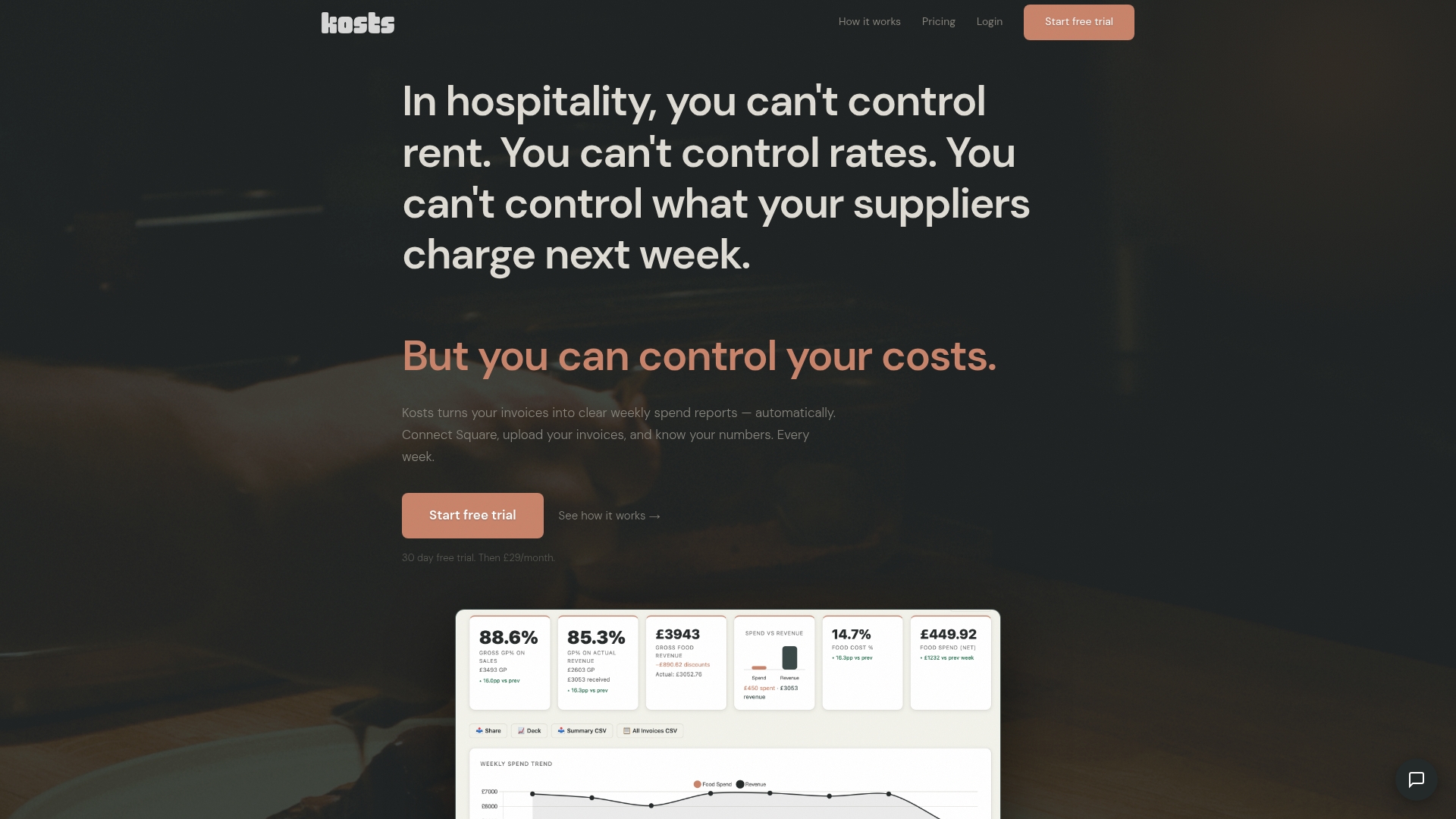
The Kosts cost tracking platform was built by a working chef specifically for independent UK restaurants. It converts your invoices into clear weekly spend reports automatically, tracks food cost percentages, and gives you a real-time dashboard of where every pound is going. You can upload invoices by photo, PDF, or email, and the platform integrates with Square and Xero to pull in your revenue data too. Try it free for 30 days and see how much clearer your finances can look.
Frequently asked questions
What are the main operating costs for UK restaurants?
The main costs include food and beverage, labour, rent, utilities, insurance, equipment, and business rates. A full breakdown of major operating expenses shows how these typically split as a percentage of revenue.
How can independent restaurants in the UK lower their operating costs?
Track costs regularly, optimise staffing and inventory, renegotiate with suppliers, and use automation to reduce admin errors. Smart expense tracking tools make this process faster and more reliable.
What is the prime cost and why does it matter?
Prime cost is the sum of cost of goods sold and labour. Keeping it under 65% of revenue is vital for maintaining a profitable margin after fixed costs are covered.
How often should restaurants review their operating costs?
Weekly reviews are recommended so you can catch overspend early and act within the same trading period. Weekly cost reviews are consistently linked to better savings outcomes for UK operators.