
TL;DR:
- Manual tracking delays cause unnoticed cost increases, eroding restaurant margins over time.
- Real-time tracking with automation enables immediate action on supplier price changes.
- Independent restaurants benefit most from simple, quick-to-implement platforms emphasizing alerts and benchmarking.
Running a restaurant on manual spreadsheets is like driving with a fogged-up windscreen. You know roughly where you are, but you cannot see what is coming. With food inflation running at 4.2 to 5.7%, even a small delay in spotting price rises can quietly drain thousands from your margins before you notice anything is wrong. This guide walks you through why real-time cost tracking matters for independent UK restaurants, how to compare your options honestly, and the practical steps to get started without disrupting your kitchen or your team.
Table of Contents
- The real cost of delayed tracking in UK restaurants
- How real-time tracking transforms financial management
- Comparing real-time tracking solutions for UK independents
- Practical steps to begin real-time tracking today
- Why real-time tracking is a game-changer for independents (our take))
- Streamline your costs with real-time solutions
- Frequently asked questions
Key Takeaways
| Point | Details |
|---|---|
| Cost creep is invisible | Slow manual tracking allows price rises to slip by, eroding profit without visible warning. |
| Simple automation beats scale | Independent restaurants benefit most from easy-to-use, real-time tools—not complex systems. |
| Immediate insight enables action | Daily alerts and flash reports give managers power to respond instantly and prevent losses. |
| Practical steps matter | Clear guidance and peer benchmarking help owners integrate real-time tracking smoothly. |
The real cost of delayed tracking in UK restaurants
Most independent restaurants still rely on a familiar routine: collect invoices throughout the week, enter figures into a spreadsheet at the weekend, and review a monthly profit and loss report. It feels organised. The problem is that by the time you spot a cost increase in that monthly report, it has already been eating into your margins for weeks.
This is what cost creep looks like in practice. A supplier quietly raises the price of a key ingredient by 5%. You do not notice because the invoice looks similar to last month. You carry on ordering the same quantities, charging the same menu prices, and wondering why your margins feel slightly tighter than usual. According to industry data, manual delays cause 3 to 5% unnoticed cost increases across food businesses operating without real-time visibility.
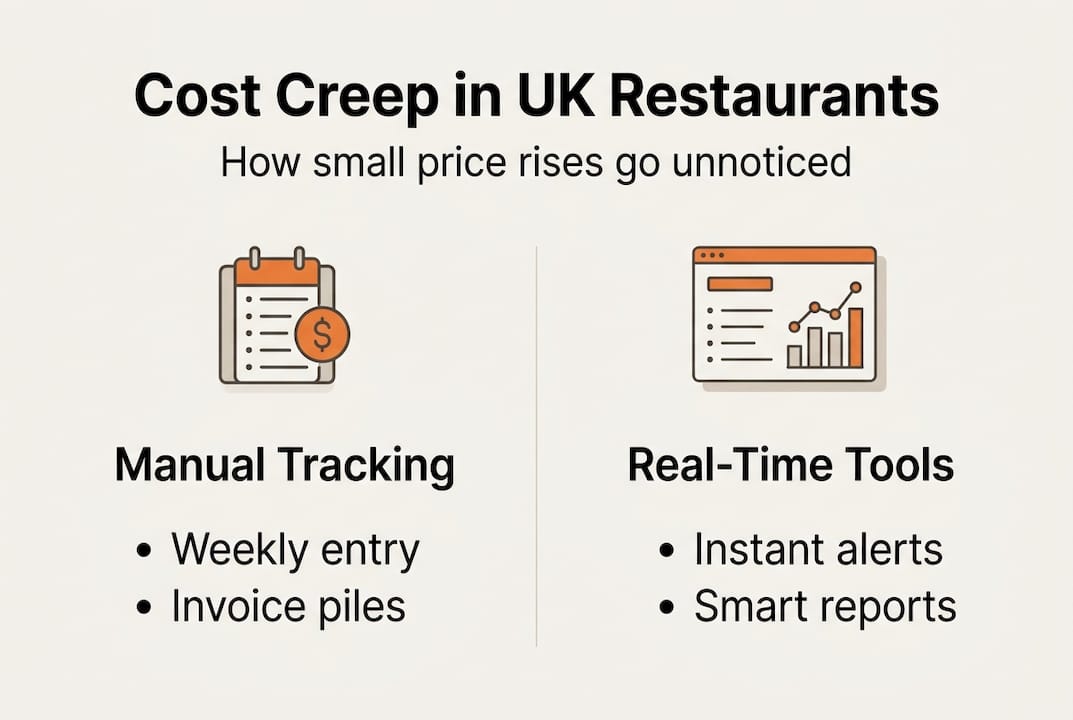
Here is a simple illustration. If your weekly food and drink spend is £1,000 and a 5% unnoticed increase goes unchallenged for a full year, that is £2,600 lost. Not from a single bad decision. From a slow, invisible drift that manual processes simply cannot catch in time.
The typical manual tracking pitfalls include:
- Invoices sitting in a pile for days before being entered
- Spreadsheets updated inconsistently across different team members
- No automatic alerts when a supplier price changes
- Monthly reports that reflect problems from three weeks ago
- No easy way to compare your spend against industry benchmarks
For practical food cost tracking tips that address these gaps, independent operators are increasingly turning to tools built specifically for the pace of restaurant life.
"The month-end review is not a financial management tool. It is a post-mortem. By the time you read it, the damage is already done."
The uncomfortable truth is that manual tracking is not just slow. It is structurally incapable of protecting your margins in a market where ingredient prices shift week to week.
How real-time tracking transforms financial management
Understanding the risks of delayed tracking sets the stage for seeing the benefits of real-time solutions. The shift is not just about speed. It changes how you make decisions and how much control you actually have over your business.
The difference between manual, daily, and real-time approaches is significant:
| Approach | Update frequency | Alert capability | Negotiation power |
|---|---|---|---|
| Manual spreadsheet | Weekly or monthly | None | Low |
| Daily flash report | Daily | Limited | Moderate |
| Real-time platform | Instant | Automated | High |
Real-time tracking means you see a supplier price change the moment an invoice is processed, not three weeks later. That gives you something genuinely valuable: the ability to act before a small increase becomes a structural problem. You can renegotiate, switch supplier, or adjust your menu pricing while the impact is still manageable.
The features that make this possible are automation, smart alerts, and integrations. When your invoices are scanned automatically and linked to your revenue data, your food cost percentage updates in real time. You do not need to calculate it manually. You just look at your dashboard. Platforms that support automated expense tracking remove the human delay from the equation entirely.
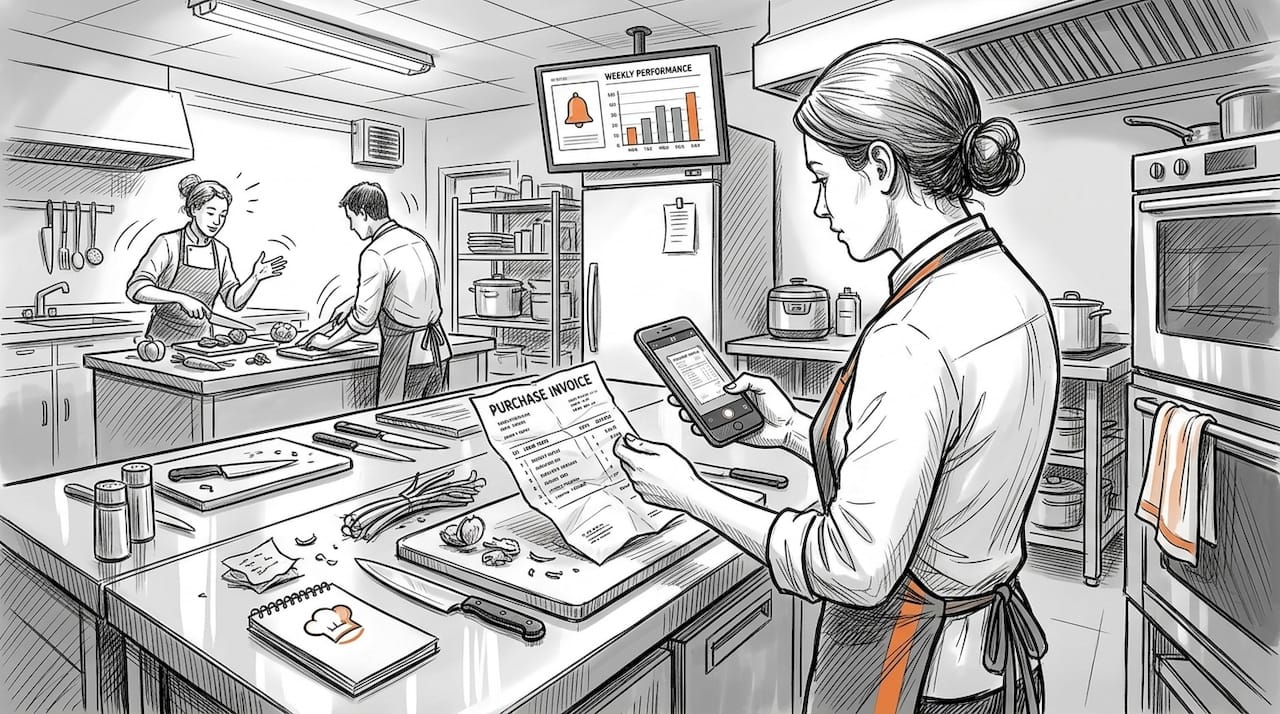
For independent restaurants, the negotiation advantage is particularly powerful. Chains have buying teams whose entire job is to monitor supplier pricing. You do not have that resource. But with real-time visibility, you can optimise restaurant costs and spot a price hike just as quickly, and respond just as decisively.
Industry research shows that independents benefit most from shifting away from monthly profit and loss reviews towards daily flash reports and simple automation. The reason is straightforward: chains have scale and dedicated finance teams. Independents have agility. Real-time tools give you the information you need to use that agility effectively.
Pro Tip: Set up a weekly flash report that shows your top five cost lines. Review it every Monday morning before your supplier orders go out. That single habit can prevent months of unnoticed cost creep.
Comparing real-time tracking solutions for UK independents
With the benefits clear, it is worth being honest about which tools actually make a difference for smaller UK businesses, because not all solutions are built with independents in mind.
Here is a straightforward comparison of the main approaches:
| Solution type | Setup time | Cost | Best for |
|---|---|---|---|
| Spreadsheets | Immediate | Free | Very small, low-volume operations |
| Generic apps | 1 to 3 days | Low | Basic expense logging |
| Specialist platforms | 1 to 7 days | Moderate | Real-time tracking with automation |
| Enterprise software | Weeks | High | Large chains and groups |
For most independent restaurants, the sweet spot is a specialist platform. Spreadsheets are free but offer no automation or alerts. Generic apps can log expenses but rarely integrate with your point of sale or accounting software. Enterprise systems are built for scale and come with complexity and cost that simply does not fit a 30-cover restaurant.
When evaluating any solution, prioritise these features:
- Simple invoice upload, whether by photo, PDF, or email forwarding
- Automatic extraction of supplier, item, and cost data
- Integration with your existing tools such as Square or Xero
- Clear dashboards showing food cost percentage and gross profit
- Peer benchmarking against UK industry standards
The benchmarking point matters more than most owners realise. Knowing your food cost is 34% is useful. Knowing that independents gain most from comparing their figures against sector benchmarks tells you whether 34% is a problem or a strength. Context transforms data into decisions.
If you want to streamline your cost control workflow, the right platform should feel like it was built for a working kitchen, not a corporate finance department. Quick onboarding, a clean interface, and relevant metrics are non-negotiable.
Practical steps to begin real-time tracking today
After comparing options, independent owners need practical steps to implement their decision and avoid the pitfalls that derail most early attempts.
Here is a clear sequence to follow:
- Choose your platform. Select a tool built for independent restaurants, not adapted from enterprise software. Prioritise ease of setup and relevant features over an exhaustive feature list you will never use.
- Connect your data feeds. Link your point of sale system and accounting software so that revenue and costs update automatically. Manual data entry defeats the purpose of real-time tracking.
- Define your alerts. Set thresholds for key cost lines. If your beef spend increases by more than 8% week on week, you want to know immediately, not at month end.
- Train your team. Anyone who handles invoices or orders needs to understand the system. A platform is only as good as the data going into it. Skipping this step is the single most common reason implementations fail.
- Review benchmarks monthly. Use industry data to sense-check your figures. Are your food costs in line with similar UK independents? If not, investigate before it compounds.
The expense tracking process you build in the first month will set the tone for everything that follows. Get the foundations right and the system largely runs itself.
Common mistakes to avoid include ignoring alerts because they feel like noise, using the platform only for invoices while still doing revenue tracking manually, and failing to review your restaurant accounting tips periodically to ensure your categories and thresholds still reflect your actual business.
As industry data confirms, real-time alerts are critical precisely because manual delays are what allow cost creep to take hold in the first place. Use your food cost control checklist as a monthly audit to stay sharp.
Pro Tip: Review your peer benchmarks at the start of each month alongside your own figures. If your costs are drifting above the sector average, you have an early warning before it becomes a crisis.
Why real-time tracking is a game-changer for independents (our take)
Here is something the standard advice rarely says plainly: the monthly profit and loss review is a habit inherited from a slower era of business. It was designed for companies with accounting departments, not for a chef-owner checking figures between a lunch service and a supplier call.
The honest lesson from working with independent restaurants is that the operators who struggle most are not the ones making bad decisions. They are the ones making decisions too late, because their information is always two or three weeks old. Real-time tracking does not make you a better businessperson. It just removes the delay between reality and your awareness of it.
Small teams do not need scale to benefit from automation. They need agility. And as UKHospitality benchmarking consistently shows, independents gain the most from simple automation precisely because they do not have the buffer of volume that chains rely on. For expense management tips that reflect this reality, the focus should always be on speed of insight, not complexity of reporting.
Streamline your costs with real-time solutions
If the manual tracking cycle is costing you more than you realise, the good news is that switching does not have to be complicated or expensive. Simple, purpose-built platforms can automate your invoice processing, flag cost increases before they compound, and give you a clear weekly picture of exactly where your money is going.
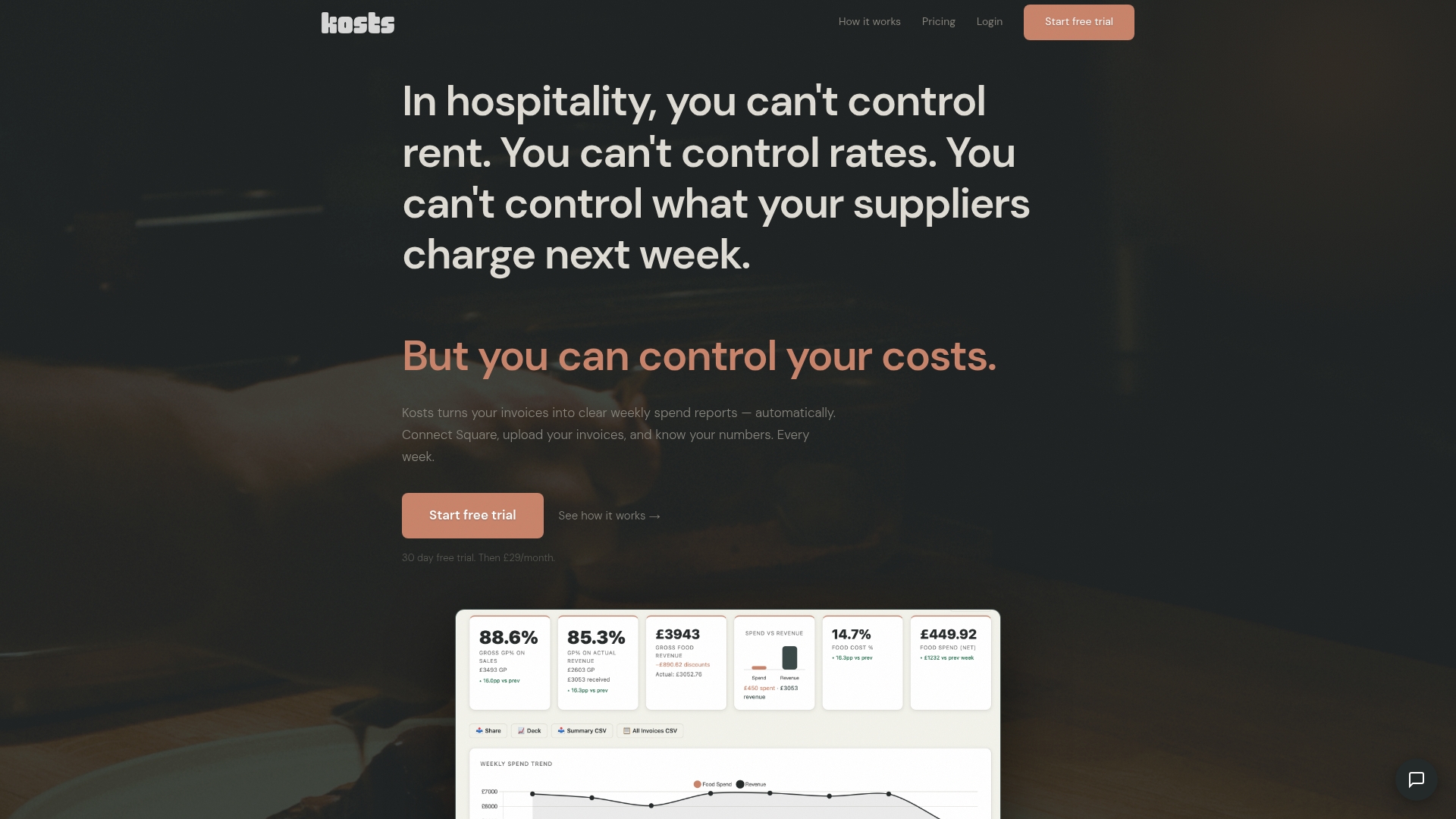
Kosts is built specifically for independent UK restaurants, by someone who has worked in professional kitchens. You can explore real-time tracking solutions with a 30-day free trial and no complex onboarding. For a deeper look at interpreting your numbers, the cost reports guide walks you through exactly what to track and why it matters for your bottom line.
Frequently asked questions
How does real-time cost tracking help UK independent restaurants?
It lets owners spot price rises the moment an invoice is processed, so they can renegotiate or adjust menus before 3 to 5% cost creep quietly erodes annual profits.
What features should independents look for in cost tracking solutions?
Prioritise simplicity, automated invoice scanning, instant alerts, and peer benchmarking. As UKHospitality data shows, independents benefit most from straightforward automation rather than complex systems built for large chains.
How quickly can an owner implement real-time cost tracking?
Most specialist platforms are fully operational within a week, provided staff are trained on invoice handling from day one. Quick onboarding is a feature worth checking before you commit to any tool.
How much can unnoticed cost creep cost a small restaurant over a year?
On a £1,000 weekly spend, a 3 to 5% unnoticed increase left unchallenged for twelve months adds up to £1,560 to £2,600 in avoidable losses, purely from delayed detection.