

Supply chain purchases are quietly responsible for over 70% of a typical UK restaurant's carbon footprint, yet most independent owners focus their sustainability efforts on recycling bins and energy-saving bulbs. The real money and the real emissions are buried in your invoices. With new UK Sustainability Reporting Standards on the horizon and diners increasingly choosing restaurants that align with their values, understanding how sustainability and accounting intersect is no longer optional. This guide walks you through the frameworks, tools, and practical strategies that help you cut costs, reduce emissions, and stay ahead of incoming compliance requirements.
Table of Contents
- Why sustainability matters for hospitality accounting
- Understanding carbon accounting frameworks in hospitality
- Tools and techniques for sustainable hospitality accounting
- Practical strategies to reduce costs and emissions
- Preparing for future reporting and regulatory changes
- How technology streamlines sustainable accounting for restaurants
- Frequently asked questions
Key Takeaways
| Point | Details |
|---|---|
| Supply chain drives emissions | Over 70% of a restaurant’s footprint comes from supply purchases, not onsite energy or waste. |
| Quick wins on energy | Upgrading kitchen equipment and lighting can cut costs by up to £3,000 per year for small restaurants. |
| Automate for compliance | Integrating accounting and sustainability tracking tools streamlines reporting for SECR, EPR, and upcoming SRS rules. |
| Menu changes yield impact | Substituting beef plus local sourcing can cut menu emissions by more than 40%. |
| Future-proof your operations | Audit carbon, waste, water and energy use now to stay ahead of reporting standards in 2026 and beyond. |
Why sustainability matters for hospitality accounting
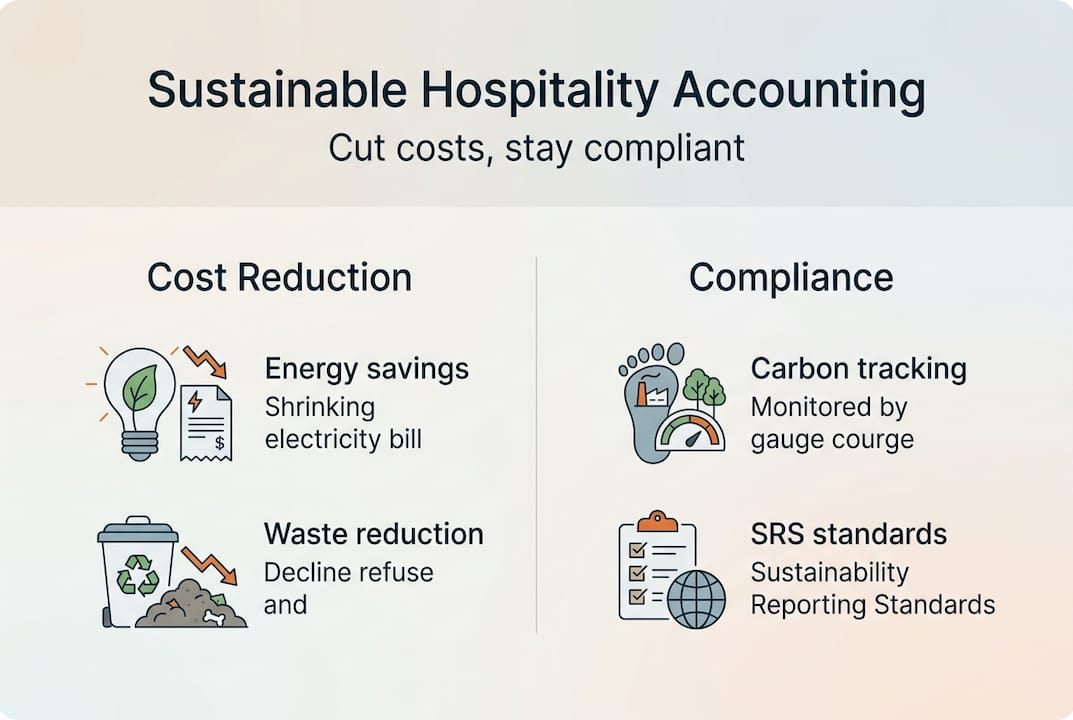
Sustainability has moved from a marketing talking point to a genuine financial and regulatory concern for UK restaurant operators. The incoming UK Sustainability Reporting Standards (SRS) align with international frameworks like TCFD and CSRD, and even if your restaurant is too small to report directly, your larger suppliers and clients will push those requirements down the supply chain to you. Ignoring this now means scrambling later.
Beyond compliance, the operational benefits are tangible:
- Waste reduction lowers food and disposal costs directly
- Energy efficiency cuts monthly utility bills by hundreds of pounds
- Local and seasonal sourcing reduces supply chain costs and carbon simultaneously
- Brand differentiation attracts the growing segment of eco-conscious diners
- Investor and lender confidence improves when you can demonstrate responsible operations
"Sustainability is no longer a nice-to-have for hospitality businesses. It is fast becoming a baseline expectation from customers, regulators, and supply chain partners alike."
Good restaurant budgeting tips already account for waste and energy, but integrating carbon thinking into your weekly and monthly accounting cycles takes that discipline to the next level. The restaurants that build these habits now will have a measurable competitive advantage within two to three years.
Understanding carbon accounting frameworks in hospitality
Carbon accounting sounds technical, but the core idea is straightforward. You measure the greenhouse gas emissions your business causes, categorise them, and then look for ways to reduce them. The dominant framework is the GHG Protocol, which divides emissions into three scopes.
| Scope | What it covers | Reporting obligation |
|---|---|---|
| Scope 1 | Direct emissions (gas boilers, company vehicles) | Mandatory under SECR for larger businesses |
| Scope 2 | Indirect energy (purchased electricity) | Mandatory under SECR for larger businesses |
| Scope 3 | Supply chain (food, drink, packaging, waste) | Voluntary under SECR, central to SRS |
Scope 3 is where the action is. Supply chain emissions dominate at over 70% of total restaurant emissions, dwarfing what comes from your gas hob or your electricity meter. Wahaca, for example, achieved a 42% reduction in menu emissions simply by reformulating dishes to reduce beef content. That is a menu decision with an accounting impact.
Key frameworks to know:
- GHG Protocol: The global standard for measuring and managing greenhouse gas emissions across all three scopes
- SECR (Streamlined Energy and Carbon Reporting): Currently mandatory for large UK companies, covers Scope 1 and 2, with Scope 3 encouraged
- SRS (Sustainability Reporting Standards): Incoming UK standards that will extend reporting requirements to cover carbon, energy, waste, and water across supply chains
For independent restaurants, the most practical starting point is your weekly spend reporting. Every invoice you process contains supplier and category data that maps directly onto Scope 3 emissions. Pair that with automated expense tracking and you have the raw data needed to begin meaningful carbon accounting without hiring a consultant.
Tools and techniques for sustainable hospitality accounting
The good news is that you do not need to build a carbon accounting system from scratch. Several tools now integrate directly with your purchasing data to automate the heavy lifting.
Carbon tracking tools like My Emissions analyse your purchase data and generate menu-level carbon labels, integrating with platforms like Kafoodle to display emissions information directly on your menu. This turns your existing invoice data into a sustainability asset.
Here is a practical quarterly audit framework to keep your restaurant on track:
- Review your food spend by category. Identify your highest-emission ingredient categories (typically beef, lamb, and dairy) and assess substitution options.
- Audit your energy usage. Compare monthly utility bills against the same period last year. Flag any anomalies and check cooking and refrigeration equipment efficiency.
- Assess your water consumption. Water audits are still rare among independent restaurants, which means early adopters stand out ahead of SRS requirements.
- Evaluate your supplier mix. Score suppliers on proximity and seasonal alignment. Local sourcing cuts both transport emissions and invoice costs.
- Export and review your spend reports. Use your accounting data to identify waste patterns and over-ordering trends before they compound.
Pro Tip: Conducting a water usage audit now, before SRS standards make it compulsory, positions your restaurant as a leader rather than a latecomer. It also frequently reveals leaks and inefficiencies that save real money.
Quarterly food and energy audits combined with local and seasonal sourcing strategies help SME restaurants prepare for SRS while cutting costs simultaneously. Use your food cost control checklist alongside these audits to ensure nothing slips through. For deeper analysis, explore proven food cost control methods and learn how analysing food costs feeds directly into profitability decisions.
Practical strategies to reduce costs and emissions
Knowing the frameworks is one thing. Cutting actual costs and emissions is another. Here is where independent restaurants can make the most immediate impact.
Energy efficiency is the fastest win. Cooking and refrigeration account for 30 to 45% of a restaurant's energy use, and monthly energy costs for small restaurants typically run between £600 and £1,200. Upgrading to induction hobs, LED lighting, and high-efficiency refrigeration units pays back quickly. Research shows that a 20% equipment efficiency gain cuts CO2e by 15.7%, while combining multiple technology upgrades achieves a 35.9% reduction.

Food waste is the silent profit killer. La Locanda, a UK restaurant that committed to a gas-free kitchen with induction cooking, LED lighting, solar panels, and biomass heating, cut food waste by 85% over two years, eliminating 1,088 kg of waste and saving approximately £3,000 per year. That is not a marginal gain. That is a meaningful contribution to the bottom line.
Pro Tip: Equipment upgrades like LED lighting, induction hobs, and solar panels often qualify for government-backed financing schemes. The payback period is typically two to four years, after which the savings are pure profit.
Key strategies at a glance:
- Switch high-emission menu items to lower-carbon alternatives
- Track food waste daily using a simple log or digital tool
- Negotiate with local suppliers for seasonal produce at better rates
- Install smart meters to monitor energy in real time
- Review your cost control workflow quarterly to catch waste before it escalates
"La Locanda's transformation shows that sustainability and profitability are not in conflict. The right operational changes deliver both."
For more inspiration on reducing waste without sacrificing quality, explore practical food waste reduction ideas that other UK restaurants are already using.
Preparing for future reporting and regulatory changes
The regulatory landscape for UK hospitality is shifting. SRS standards will require restaurants to report on carbon, energy, waste, and water, and Whitbread's early alignment with SASB and SECR frameworks demonstrates what best practice looks like at scale. Independent operators who start building these habits now will find compliance far less disruptive when it becomes mandatory.
Here is a simple roadmap for getting ahead:
- Start tracking Scope 3 data now. Your purchase invoices are the foundation. Organise them by supplier and category every week.
- Establish energy and water baselines. You cannot reduce what you have not measured. Set monthly benchmarks for both utilities.
- Document your waste reduction efforts. Keep records of food waste logs, supplier changes, and menu reformulations.
- Review your accounting systems. Ensure your software can export spend data by category, supplier, and time period for future reporting.
- Stay informed on SRS timelines. UKHospitality publishes updates regularly. Subscribe and act early.
Benefits of early compliance preparation:
- Avoid last-minute costs and operational disruption
- Demonstrate credibility to suppliers, lenders, and customers
- Identify cost-saving opportunities before they become compliance obligations
- Build internal reporting habits that improve overall financial discipline
Good budgeting for compliance means treating sustainability reporting as a line item in your operational planning, not an afterthought. The restaurants that treat it this way will be better run across the board.
How technology streamlines sustainable accounting for restaurants
Every strategy in this article depends on one thing: clean, organised data. Without visibility into what you are spending, on what, and with whom, carbon accounting and cost control are guesswork. That is exactly the problem that Kosts was built to solve.
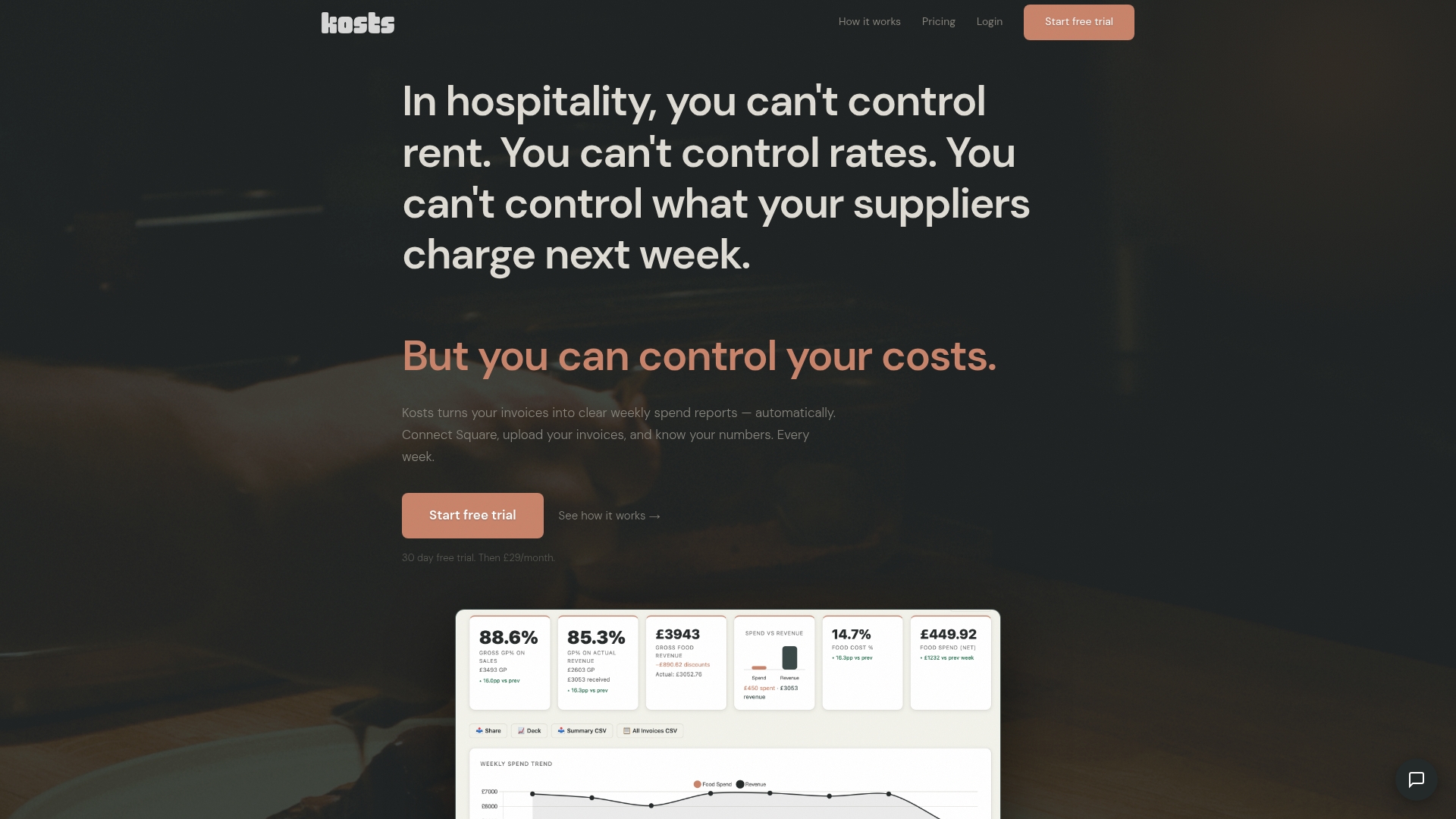
Kosts converts your invoices into automated weekly spend reports, breaking down costs by supplier, category, and time period. Built by a working chef who understood the gap between complex accounting software and the reality of a busy kitchen, it gives independent restaurant owners the financial clarity they need to act on sustainability goals. Whether you are preparing for SRS compliance, trying to reduce your food cost percentage, or simply want to stop overspending on ingredients, the cost control checklist and Kosts platform together give you a practical starting point. Try it free for 30 days and see what your data has been hiding.
Frequently asked questions
How can my restaurant start tracking Scope 3 emissions?
Use purchase-integrated platforms like My Emissions to automate Scope 3 tracking. These tools analyse your supply chain data and generate menu-level carbon labels without requiring specialist knowledge.
What practical steps reduce energy costs in small restaurants?
Upgrade cooking and refrigeration equipment first, as these account for the largest share of energy use. Monthly energy costs for small restaurants range from £600 to £1,200, and equipment upgrades can cut these significantly within the first year.
Do I need to comply with SRS standards in 2026?
Direct SRS obligations are still being phased in, but SRS requirements will affect hospitality supply chains sooner than many expect. Auditing your carbon, energy, waste, and water usage now puts you well ahead of the curve.
Which menu changes have the biggest sustainability impact?
Reducing beef and lamb content has the most immediate effect. Menu emission cuts of up to 42% are achievable through reformulation, and switching to local, seasonal sourcing reduces both supply chain carbon and ingredient costs at the same time.