
TL;DR:
- UK independent restaurants operate on very slim profit margins, making food cost control vital.
- The best food cost calculators offer ingredient-level breakdowns, real-time updates, and system integrations.
- Choosing the right tool depends on your restaurant size, menu complexity, and specific operational needs.
Food costs are squeezing UK restaurant margins harder than ever. With profit margin statistics showing that independents frequently operate on net margins as slim as 2 to 6%, every pound spent on ingredients must earn its place on the menu. The good news is that food cost calculators have evolved from clunky spreadsheets into smart, accessible tools that give you real visibility into what your kitchen is actually costing you. This article walks you through what to look for, which tools are worth your attention, how they compare, and how to pick the right one for your restaurant.
Table of Contents
- What to look for in a food cost calculator
- Top examples of food cost calculators for UK independents
- Comparing leading food cost calculators: Features and results
- When to use which calculator: Making the right choice
- Our perspective: Why the right calculator transforms restaurant profit
- Take control of food costs with the right solution
- Frequently asked questions
Key Takeaways
| Point | Details |
|---|---|
| Prioritise smart features | The best food cost calculators provide ingredient breakdowns, margin analysis, and reporting for UK restaurants. |
| Match tool to your venue | Select calculators that align with your restaurant’s size and workflow to maximise both simplicity and savings. |
| Technology drives profits | Modern, cloud-based calculators offer critical insights that help independents thrive despite narrow margins. |
| Test before investing | Use free trials and demos to ensure the solution fits your business before committing long-term. |
What to look for in a food cost calculator
Not every calculator is built with an independent restaurant in mind. Larger platforms often bundle features you will never use whilst burying the ones you actually need. Before committing to any tool, it is worth knowing which features genuinely move the needle.
The most important features to prioritise include:
- Ingredient-level breakdowns: You need to see the cost of every component in a dish, not just a blended total.
- Recipe costing: The ability to build and price recipes individually, factoring in portion sizes and waste.
- Menu analysis: Identify which dishes are profitable and which are quietly draining your margins.
- Reporting tools: Weekly, monthly, or category-based reports that show spending patterns over time.
- Integration with ordering and accounting systems: Syncing with tools like Xero or your supplier invoices can save several hours each week.
Cloud-based calculators are particularly useful for independent restaurants with small teams. They allow your head chef, manager, and owner to access the same live data from different devices, so decisions are based on shared information rather than someone's best guess.
For context, monitoring food costs consistently is one of the highest-impact habits a restaurant can build. The best calculators make that habit nearly effortless by automating data entry and surfacing the right numbers automatically.
As food cost calculators help UK restaurant managers track key data for better profitability, the return on even a modest monthly subscription tends to be quick. Independent restaurants operate with far slimmer margins than chains, so efficiency tools are not a luxury but a necessity.
Pro Tip: Prioritise calculators that display real-time gross and net margin updates per dish. Knowing your margin before you finalise a menu price is far more powerful than calculating it after the fact.
Useful tracking tips for UK restaurants suggest that even logging spend weekly, rather than monthly, dramatically improves a restaurant's ability to react to price increases before they compound.
Top examples of food cost calculators for UK independents
With the right evaluation criteria in place, here are the tools most worth your attention as a UK independent.
- Kosts food cost calculator: Built by a working chef with independent restaurants firmly in mind. Offers recipe-level costing, mobile invoice scanning, and a UK-centric dashboard that shows food cost percentage and gross profit at a glance. Designed for operators who want clarity without complexity.
- FreeFoodCost.com: A no-frills, browser-based calculator that works like an interactive spreadsheet. Ideal if you are just getting started with structured food costing and want a free entry point with minimal setup.
- KitchenNmbrs calculator: A more advanced option with detailed ingredient tracking and the ability to handle high-volume, fast-moving kitchens. Better suited to busy cafés or kitchens with complex menus.
- Spreadsheet templates: Custom-built Excel or Google Sheets solutions work well for hands-on owners who want full control. The trade-off is time: manual updates, no automation, and a higher risk of errors.
Key strengths to note across these options:
- Kosts offers the most relevant feature set for UK independents, including invoice scanning and Xero integration.
- FreeFoodCost.com is the quickest to get started with, though it lacks integration and automation.
- KitchenNmbrs suits operators who need granular ingredient-level data across a large menu.
- Spreadsheets remain useful for one-off calculations but struggle as a day-to-day management tool.
For anyone weighing up whether to invest in a paid tool, free alternatives in 2026 are worth exploring before committing to a subscription. Many reputable platforms now offer 30-day free trials with full feature access.
Pro Tip: Always test a free version or trial before purchasing. A tool that looks impressive in a demo may feel clunky in a real kitchen workflow.
Net profit margins for independents are consistently lower than for chains, which makes the choice of calculator more consequential than it might appear. The right tool does not just save time; it directly protects your bottom line.

Comparing leading food cost calculators: Features and results
With the leading options in view, it is critical to compare their features directly so you can make an informed choice.
| Feature | Kosts | FreeFoodCost.com | KitchenNmbrs | Spreadsheet |
|---|---|---|---|---|
| Recipe costing | ✓ | ✓ | ✓ | Manual |
| Menu engineering | ✓ | Limited | ✓ | Manual |
| Real-time price updates | ✓ | ✗ | ✓ | Manual |
| Accounting integration | ✓ (Xero, Square) | ✗ | Partial | ✗ |
| Mobile access | ✓ | ✓ | ✓ | Limited |
| UK-specific interface | ✓ | ✗ | ✗ | N/A |
| Free to start | Trial | ✓ | Trial | ✓ |
At a glance, a small bistro with a tight team and limited time is best served by Kosts or FreeFoodCost.com. A high-volume café juggling dozens of ingredients daily will benefit more from KitchenNmbrs or a customised spreadsheet with structured categories.
The cost control checklist for UK restaurants reinforces that matching your tool to your kitchen's actual workflow is more important than choosing the most feature-rich option.
"Fine dining venues typically accept higher allowable food costs in exchange for premium ingredient quality and elevated portion presentation. Their calculators need to reflect that trade-off, not fight against it."
It is also worth noting that proven control methods across UK restaurants consistently highlight the importance of setting target food cost percentages by category. Targets vary: casual venues often aim for 28 to 32%, while quality-focused kitchens may run closer to 30 to 35%.
The right calculator should make it easy to track actual performance against those targets on a rolling basis, not just at month end.
When to use which calculator: Making the right choice
Selecting the right tool matters as much as knowing what is available. Here is how to decide based on your specific situation.
| Business type | Recommended tool | Primary benefit |
|---|---|---|
| Small café or coffee shop | FreeFoodCost.com or Kosts | Quick setup, low overhead |
| Independent bistro or brasserie | Kosts | Recipe costing, invoice scanning, UK dashboard |
| Gastropub with seasonal menu | Kosts or KitchenNmbrs | Ingredient tracking across changing menus |
| Fine dining restaurant | KitchenNmbrs or Kosts | Granular costing, margin visibility |
| Home-based or pop-up operator | Spreadsheet or FreeFoodCost.com | Flexibility, low cost |
A structured approach to selection will save you from tool-switching later. Follow these steps:
- Audit your current process. How are you tracking food costs right now? Manual? Not at all? Your starting point shapes what you need most.
- List your non-negotiables. Do you need Xero integration? Mobile access? Recipe-level costing? Define your must-haves before looking at options.
- Trial before committing. Use free versions or trial periods to test the tool in your actual kitchen environment, not a theoretical one.
- Involve your team. If your head chef or kitchen manager will not use it, it will not work regardless of how good it is.
- Review after 30 days. Check whether the tool is giving you actionable insights or just producing numbers you do not know what to do with.
For operators who want to deepen their understanding of what the numbers mean once they have them, analysing food costs is a practical next step that helps translate raw data into pricing and purchasing decisions.
With independents operating on 2 to 6% net margins, there is genuinely no room for guesswork. A well-chosen calculator does not just track spending; it gives you the confidence to make faster, better decisions every week.
Our perspective: Why the right calculator transforms restaurant profit
There is a persistent myth in UK hospitality that sophisticated cost tools are for large chains with dedicated finance teams. That thinking is outdated and, frankly, expensive.
The reality is that independents have the most to gain from these tools. When your margins are wafer-thin and your team is small, a calculator that surfaces a 4% food cost overspend is not just useful; it is the difference between a profitable month and a loss. Using financial data to drive decisions is no longer optional in this market.
What we have observed is that the main barrier is not cost or technical complexity. It is resistance to changing how things have always been done. Most operators who commit to a proper food cost tool for 60 days do not go back. The clarity it provides changes how they think about menus, purchasing, and pricing in ways that gut instinct simply cannot replicate.
Calculators are not just about maths. They are about making smarter decisions faster, with less stress and more confidence.
Take control of food costs with the right solution
If this article has made one thing clear, it is that the right food cost calculator does not just save time; it actively protects your profitability. The tools exist, the pricing is accessible, and the learning curve is shorter than most operators expect.
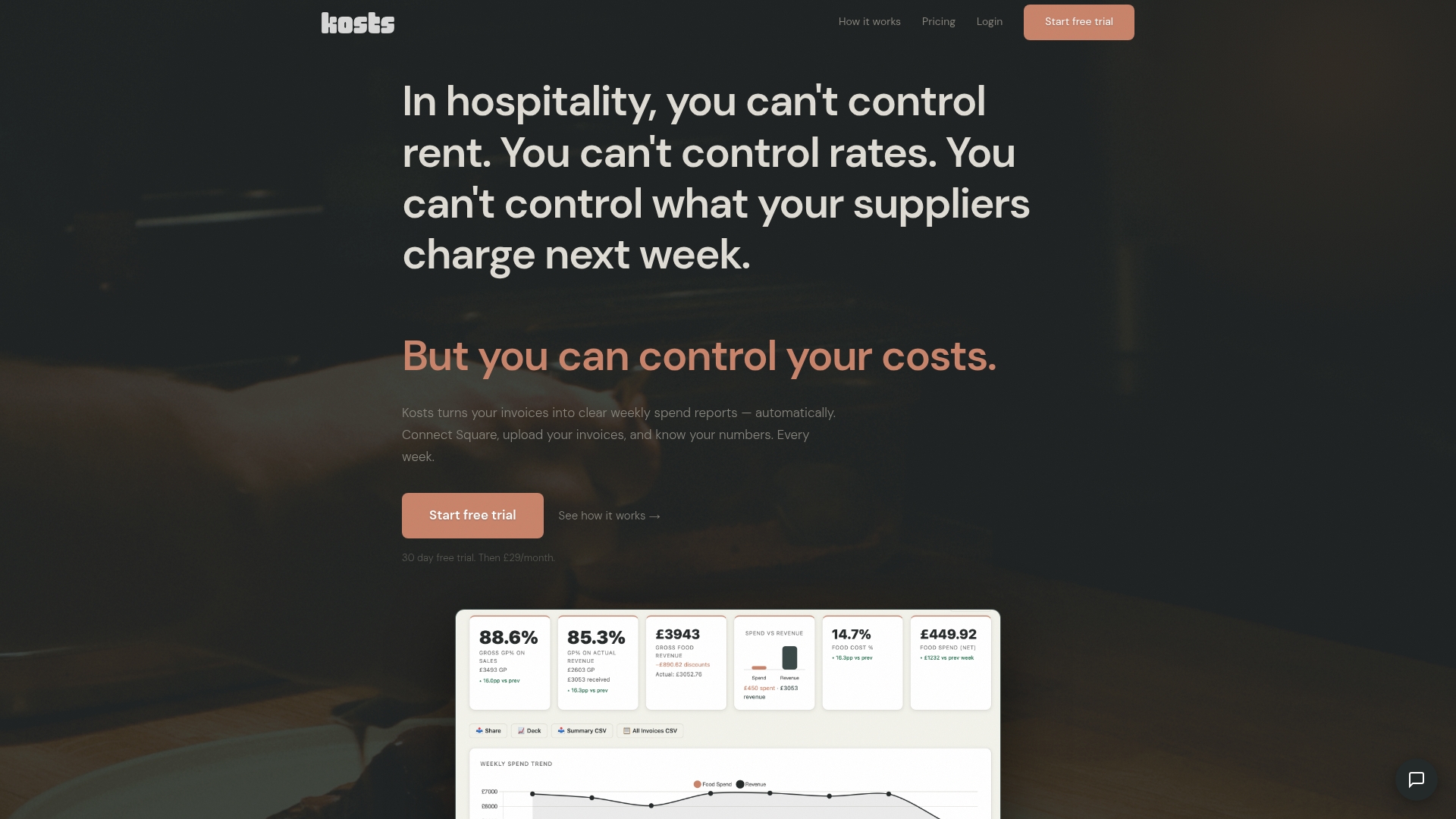
Kosts was built specifically for UK independent restaurants, with the kind of features that matter in a real kitchen environment: invoice scanning, recipe costing, automated weekly reports, and integration with Xero and Square. You can discover Kosts food cost calculator and start a 30-day free trial with no commitment required. If you have been managing costs on instinct alone, this is a straightforward way to put real data behind your decisions.
Frequently asked questions
What is a food cost calculator and why do UK restaurants need one?
A food cost calculator helps you track and analyse ingredient spending, recipe costs, and menu profitability. For UK restaurants with tight margins, key data tracking through these tools is essential for sustainable profitability.
Are free food cost calculators effective for small restaurants?
Free tools can handle basic tracking well, but paid options provide deeper analytics and integrations that grow with your business. Reputable free alternatives are worth testing before committing to a paid plan.
How do margins for independent UK restaurants compare to chains?
Independents often run on net margins of 2 to 6%, while larger chains can reach closer to 10%. That gap makes effective cost control far more urgent for independents.
What features should I look for when choosing a food cost calculator?
Prioritise ingredient costing, real-time price updates, and integration with your accounting or ordering systems. Essential tools include ingredient breakdowns, recipe costing, and clear reporting to support daily decisions.