

TL;DR:
- Independent restaurants can outperform chains in supplier cost control with proper tracking tools.
- Real-time expense monitoring reveals errors, price surges, and opportunities to optimize spend quickly.
- Automated systems simplify invoice management, enabling faster response and better supplier negotiation.
Most independent restaurant owners assume supplier cost control is a game only the big chains can win. After all, chains have buying power, dedicated procurement teams, and enterprise software. But that assumption is costing you money. Supplier purchases are typically the second largest cost after wages, and without clear visibility, price creep, delivery errors, and over-ordering quietly erode your margins every week. The good news is that independents have real advantages here, and with the right tracking in place, you can outmanoeuvre chains in ways that matter most to your bottom line.
Table of Contents
- The true cost of supplier spending for restaurants
- The benefits of tracking supplier spending in real time
- How automated expense tracking tools transform supplier management
- How to get started: Practical steps for tracking supplier spending
- Why UK independents have a hidden edge in supplier spending
- Take control of your restaurant's supplier spend today
- Frequently asked questions
Key Takeaways
| Point | Details |
|---|---|
| Supplier spend is critical | Supplier costs are among the top expenses and directly impact your profit margins. |
| Tracking prevents overspend | Systematic tracking highlights price increases, over-ordering, and billing errors quickly. |
| Automation gives independents edge | Automated tools give independent restaurants the agility to manage risk and save money. |
| Diversify for resilience | Relying on several suppliers, not just one, reduces risk in today's supply chain climate. |
The true cost of supplier spending for restaurants
Supplier invoices are not just receipts. They are a live record of where your money goes, and for most UK restaurants, that is a significant amount. Food and beverage purchases alone typically represent 25 to 35% of total revenue, making them second only to staff wages as your biggest recurring cost. Yet many independent operators still manage this spend reactively, reviewing invoices only when something feels wrong.
The hidden costs are where it gets painful. Consider these common pitfalls:
- Price inflation baked into invoices: Suppliers quietly raise unit prices by small amounts. Without line-by-line tracking, these increases go unnoticed for months.
- Minimum order penalties: Missing a supplier's minimum order threshold triggers fees that rarely appear as a separate line item.
- Delivery discrepancies: You are charged for 10 cases of olive oil but only 9 arrive. Manual checking is slow and errors get missed.
- Over-ordering and spoilage: Without spend data, it is easy to over-purchase perishables, leading to waste that directly cuts into gross profit.
Here is a simple illustration of how unchecked supplier costs compare to tracked ones over a quarter:
| Cost area | Untracked spend | Tracked spend |
|---|---|---|
| Price inflation (quarterly) | +4.5% unnoticed | Flagged within 1 week |
| Delivery errors | 2 to 3 per month | Resolved same week |
| Over-ordering waste | 8 to 12% of food budget | Reduced to under 4% |
| Supplier diversification | 1 to 2 main vendors | 4 to 5 active vendors |
"Restaurants that over-rely on one supplier face heightened supply chain risk, particularly in the post-Brexit environment where import delays and price volatility are more common."
Post-Brexit disruptions have made single-supplier dependency genuinely dangerous. Delays at ports, new import paperwork, and currency fluctuations all affect what you pay and when you receive goods. Smart restaurant expense tracking is no longer a nice-to-have. It is a core part of protecting your margins in a volatile supply environment.
The benefits of tracking supplier spending in real time
Real-time visibility changes the way you make decisions. Instead of discovering a price rise at month-end when the damage is done, you see it the moment an invoice is processed. That shift from reactive to proactive is where independent restaurants gain a genuine edge.
Here is how real-time tracking directly benefits your operation:
- Catch errors immediately: Discrepancies between purchase orders and invoices surface instantly, not weeks later.
- Spot price surges early: If a key ingredient rises 10% this week, you know before it affects your food cost percentage.
- Compare supplier performance: Side-by-side spend data lets you evaluate whether switching vendors makes financial sense.
- Negotiate from a position of strength: Walking into a supplier meeting with 12 weeks of spend data is far more persuasive than a gut feeling.
- Diversify sourcing with confidence: When you can see exactly what you spend with each vendor, reducing reliance on any single one becomes a straightforward decision.
Independents who use real-time supplier spend tracking consistently report that they find savings they did not know existed. One common example: a restaurant owner discovers they are buying the same product from two different suppliers at different prices, simply because orders were placed by different staff members on different days.
| Tracking method | Response time to price change | Supplier error detection | Negotiation leverage |
|---|---|---|---|
| Manual spreadsheet | 2 to 4 weeks | Low | Minimal |
| Monthly accounting review | 3 to 5 weeks | Very low | Minimal |
| Real-time automated tracking | Same week | High | Strong |
The agility that independents naturally have through local sourcing relationships becomes a genuine competitive advantage when it is backed by accurate spend data. You can pivot to a new local supplier in days. A chain cannot.
Pro Tip: Set a weekly 15-minute review of your top five supplier invoices. This single habit, supported by automated data, will surface more savings than any annual audit.
How automated expense tracking tools transform supplier management
The jump from manual tracking to automated tools is not just about convenience. It fundamentally changes what is possible for a small team running a busy kitchen.
Manual spreadsheets require someone to enter data, check it, and maintain it consistently. In practice, that means it gets done poorly or not at all during busy periods. Automated tools remove the data entry burden entirely. You photograph an invoice, forward an email, or upload a PDF, and the system extracts supplier name, item, category, and cost automatically.
Here is what automated expense tracking makes possible that manual methods simply cannot:
- Spend alerts by supplier: Set a threshold for each vendor. If your meat supplier's weekly total exceeds a set figure, you get an alert before the invoice is approved.
- Prime cost reporting: See your combined food and labour cost as a percentage of revenue, updated weekly without manual calculation.
- Category breakdowns: Understand exactly how much you spend on produce, dairy, dry goods, and beverages, broken down by week, month, or quarter.
- Supplier exposure reports: Identify your top five suppliers by spend and assess how much risk sits with each one.
Automated solutions help you identify top supplier exposures and enable agile switching when a vendor raises prices or becomes unreliable. That kind of insight used to require a finance team. Now it is available to any independent operator with a smartphone.

Pro Tip: Use your weekly spend report checklist to build a consistent review rhythm. Consistency matters more than complexity when you are building financial control habits.
Key stat: Restaurants that review supplier spend weekly are significantly more likely to identify and act on cost-saving opportunities before they become profit problems.
How to get started: Practical steps for tracking supplier spending
Knowing the benefits is one thing. Building a process that actually sticks in a busy restaurant is another. Here is a practical sequence to get you from zero to fully in control.
- Audit your last 90 days of invoices: Gather every supplier invoice from the past three months. Categorise each one by supplier and cost type. This gives you a baseline and will immediately reveal patterns you were not aware of.
- Identify your top five suppliers by spend: These are your highest-risk and highest-opportunity relationships. Focus your attention here first.
- Choose an automated tracking tool: Look for something built for restaurants, not generic accounting software. You need invoice scanning, category tagging, and weekly reporting as standard features.
- Onboard your team: The person placing orders needs to understand why every invoice must be logged. Frame it as protecting their job by keeping the business healthy, not as extra admin.
- Set a weekly review rhythm: Every Monday morning, spend 20 minutes reviewing last week's supplier spend. Flag anything unusual and carry any actions forward.
- Schedule monthly analysis and annual renegotiation: Monthly reviews spot trends. Annual renegotiations, backed by a full year of spend data, give you real leverage with suppliers.
The advice on supplier management from industry experts consistently points to one priority: diversify your top five suppliers and maintain the ability to switch quickly. Your tracking system is what makes that possible in practice.
Building a solid expense tracking process does not need to be complicated. Start simple, stay consistent, and use expense management tips to refine your approach as you go.
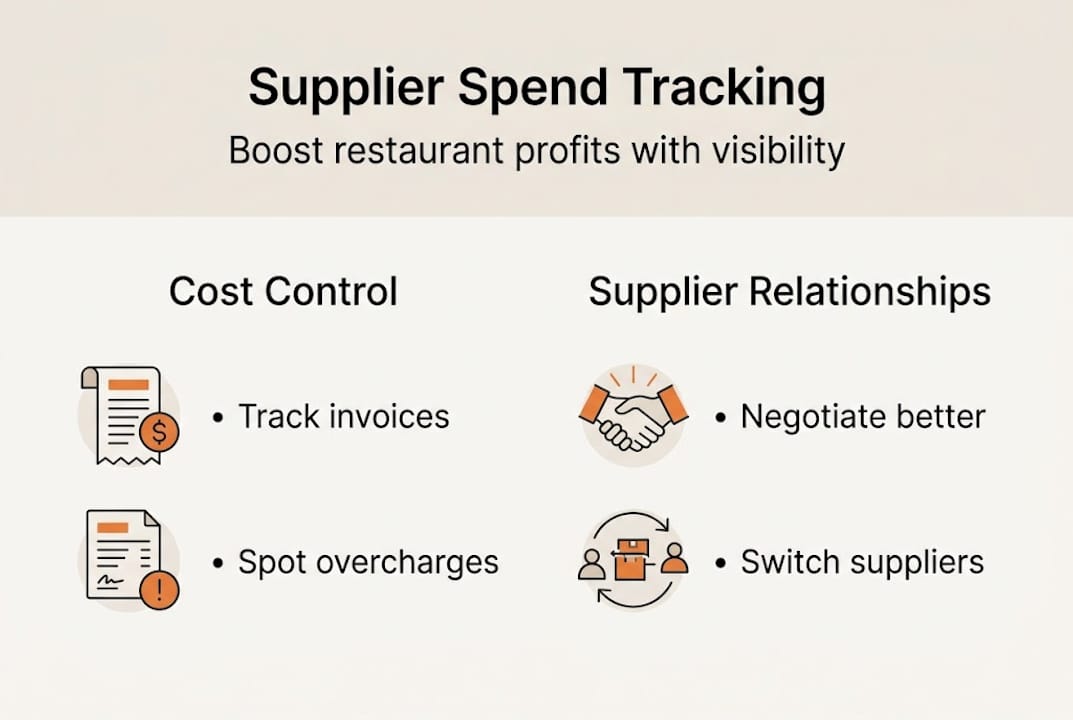
Pro Tip: When onboarding staff to a new tracking system, run a short demo using a real invoice from your busiest supplier. Seeing their own familiar data in the tool makes adoption far quicker than any training document.
Why UK independents have a hidden edge in supplier spending
Here is a perspective that does not get enough airtime: independent restaurants are not at a disadvantage in supplier cost control. They are at an advantage, provided they use the right tools.
Chains operate on scale discounts, yes. But they also operate on rigid procurement processes, centralised decision-making, and slow response times. When a local supplier raises prices or a product becomes unavailable, a chain takes weeks to adjust. You can make that call by Friday.
Independents excel through agility and local sourcing, and that agility is worth real money when it is backed by data. The problem has never been that independents lack leverage. It is that they have not had the visibility to use it. Automated tracking closes that gap entirely.
With clear spend data, your local relationships become a strategic asset rather than a convenience. You know exactly what you spend, with whom, and what alternatives exist. That is a position most chain procurement managers would envy. Reviewing your operating cost tips regularly keeps that edge sharp.
Take control of your restaurant's supplier spend today
Understanding your supplier spend is the foundation of genuine cost control, and the tools to do it properly are now well within reach for any independent restaurant.
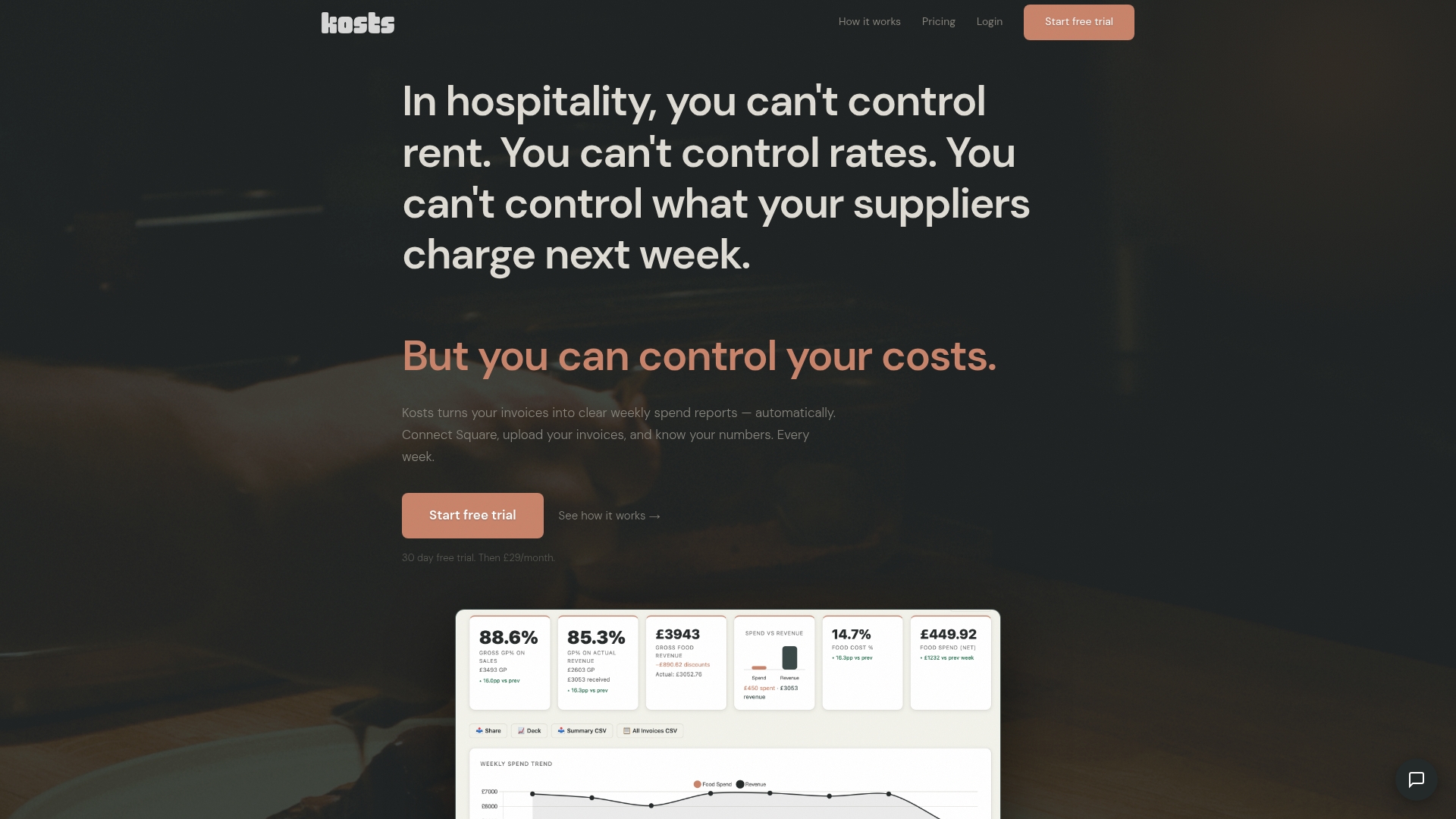
Kosts is built specifically for independent UK restaurants and food service businesses. You can upload invoices by photo, PDF, or email forwarding, and the platform automatically extracts supplier, item, category, and cost data for you. Weekly spend reports, food cost percentages, and supplier breakdowns are all generated without a spreadsheet in sight. If you are ready to move from guesswork to clarity, the automated restaurant expense tracker from Kosts comes with a 30-day free trial and straightforward monthly pricing. No complex setup. No enterprise contracts.
Frequently asked questions
What percentage of a restaurant's costs typically come from suppliers?
For most UK restaurants, supplier expenses account for 25 to 35% of total costs, making them second only to staff wages as the largest recurring expenditure.
How can automated tracking help avoid supplier overcharges?
Automated tools detect invoice discrepancies instantly by comparing expected costs against actual charges, alerting you to errors before payments are processed.
Is it risky to rely on one main restaurant supplier after Brexit?
Yes. Over-reliance on one supplier significantly increases supply chain risk, and diversifying across multiple vendors is now strongly advised for UK restaurants operating post-Brexit.
What is the first step to improving supplier spend management?
Begin by auditing your last 90 days of supplier invoices and categorising every recurring cost by vendor and type to establish an accurate, actionable baseline.